

Table of Contents
- Why Apartment Cardio Workouts Matter
- Low-Impact Cardio for Small Spaces
- HIIT Workouts for Small Spaces
- Noise Reduction Techniques for Neighbors
- At-Home Cardio Equipment for Small Apartments
- Sample Apartment Cardio Circuits
- Progressive Overload in Limited Space
- Recovery and Cool-Down for Apartment Training
- Frequently Asked Questions
Last Updated: September 29, 2026
Why Apartment Cardio Workouts Matter
Apartment cardio workouts solve a real problem: traditional cardio requires space and creates noise. The solution is matching your workout to your environment, finding movements that elevate your heart rate in a small space without disturbing neighbors.
This guide covers apartment cardio workouts that work: specific exercises, noise-reduction techniques, and sample circuits you can start today.
Low-Impact Cardio for Small Spaces
Low-impact cardio keeps one foot in contact with the ground, reducing joint stress and eliminating jumping noise. Contrary to assumption, low-impact doesn't mean low intensity, you can elevate your heart rate significantly without leaving the ground.
High Knees and Mountain Climbers
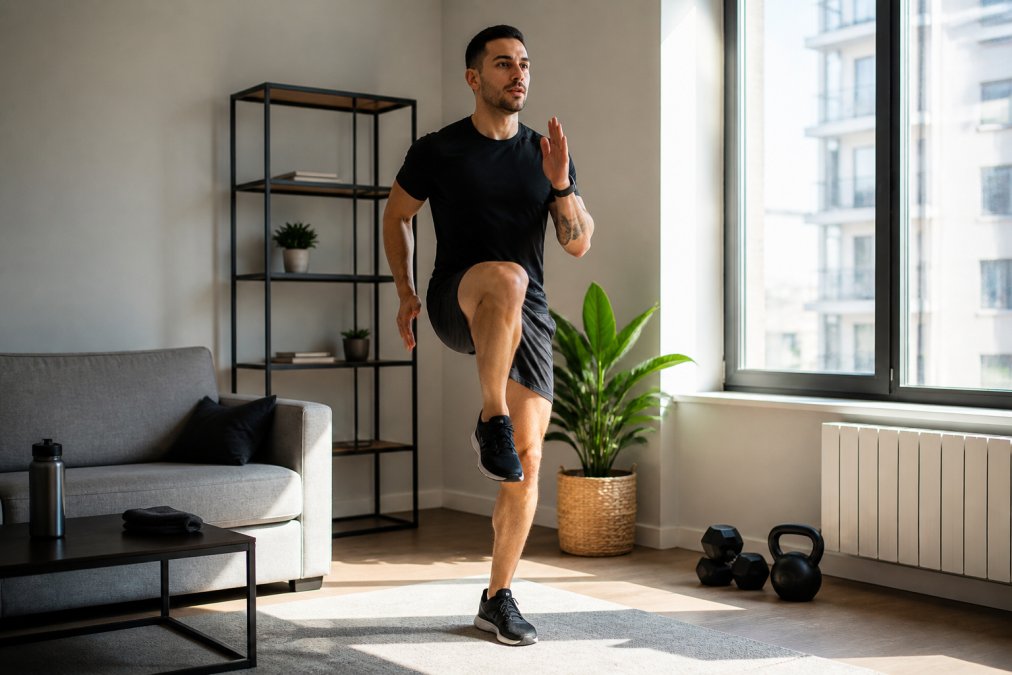
High knees drive your knees toward your chest in rapid succession, building endurance and engaging your core in minimal space. Mountain climbers combine upper body stability with lower body intensity from a plank position. Both elevate your heart rate quickly and execute silently, your feet stay on the ground.
Lateral Lunges and Skaters
Lateral lunges work your glutes and quads while building lateral stability. Skaters mimic ice skating, push off one leg, land on the other, and reverse. Both are silent, apartment-friendly movements that target muscle groups traditional cardio ignores.
HIIT Workouts for Small Spaces
High-intensity interval training alternates between maximum-effort bursts and recovery periods. HIIT workouts deliver cardiovascular benefits in 15-20 minutes with metabolic effects extending beyond the session.
30-Second Burst Protocol
The simplest HIIT structure: 30 seconds maximum effort, 30 seconds rest, repeated 10-15 rounds. Pick one movement per round (high knees, mountain climbers, skaters). This works because short bursts separated by adequate recovery are sustainable, most people maintain true intensity for 30 seconds.
Beginner-Friendly HIIT Modifications
Beginners should start with longer recovery: 20 seconds work, 40 seconds rest, or reduce total rounds to 6 instead of 15. Apartment cardio workouts should feel challenging but sustainable, if you're gasping after round 3, your intensity was too high.
Noise Reduction Techniques for Neighbors
Noise is the apartment cardio killer, but it's not inevitable, it's a byproduct of specific movement patterns and floor contact mechanics. Understanding why certain exercises sound loud gives you control over your impact on neighbors.
Understanding Impact Noise vs. Vibration Noise
Apartment cardio produces two types of sound: impact noise (foot landing) from exercises like jump rope and burpees, and vibration noise (building rumble) from rhythmic movements like high knees and mountain climbers. Low-impact cardio eliminates impact noise but requires technique to reduce vibration.

Landing Mechanics: The Heel-to-Toe Rule
Land toe-first, then roll through to your heel, this distributes force and dampens sound by 60-70% compared to heel-first landing. For skaters and lateral lunges, touch your toes down first, then lower your heel. This dancer-like movement is controlled, quiet, and intense.
Vibration Dampening: Mats, Rugs, and Placement
An 8mm exercise mat reduces vibration by 40-50%; layering with a thick area rug adds another 20-30% reduction. Placement matters too, move your workout to a corner away from the center of the room to reduce vibration transmission to neighbors below.
Movement Tempo and Rhythm Control
Rhythmic movements create building resonance. Vary your tempo to prevent resonance at a single frequency, or choose non-rhythmic movements like lateral lunges instead of rhythmic ones like mountain climbers.
Timing and Neighbor Awareness
Avoid early morning (before 7 a.m.) and late evening (after 9 p.m.) workouts. If you share a wall with neighbors, avoid lateral movements like skaters and lateral lunges against that wall.
The Noise-Reduction Hierarchy
Rank your noise-reduction strategy: (1) Choose low-impact movements (high knees, mountain climbers, lateral lunges, skaters). (2) Refine landing technique, toe-first reduces impact noise 60-70%. (3) Add an 8mm exercise mat (40-50% vibration reduction). (4) Layer with a thick rug (additional 20-30% reduction). (5) Vary tempo to avoid resonance. (6) Time workouts strategically (avoid early morning and late evening). Most apartment dwellers solve 80% of noise problems with steps 1-2 alone.
At-Home Cardio Equipment for Small Apartments
Equipment isn't required for apartment cardio workouts, but the right tools expand your options and enable progressive overload without increasing your footprint.
Commercial Equipment for Noise Reduction and Intensity
A mini stepper (12 inches wide, 16 inches deep) is nearly silent and elevates your heart rate while engaging your legs without impact noise. It's valuable for quiet, space-efficient resistance work.
Jump rope mats reduce rope impact noise by 60-70%, non-negotiable for apartment cardio workouts. Resistance bands add intensity without floor space; attach to a door anchor for pulling movements that complement lower body cardio.
Resistance Band Door Anchor Set – Pull →

Household Items as Progressive Overload Tools
Household items provide free progressive overload: water bottles (1-liter = 2.2 lbs, gallon = 8.3 lbs) as hand weights during lunges and skaters; sturdy chairs for step-ups and dips; towels for isometric resistance during planks; backpacks filled with books (start 5-10 lbs) for weighted movements. Backpacks distribute weight safely across shoulders and back.
Resistance from body positioning: You don't always need external load. Elevate your feet during mountain climbers (feet on a chair, hands on the floor) to increase difficulty. Perform skaters with a wider lateral distance to increase range of motion and intensity. Do lateral lunges with a deeper squat to increase time under tension. These are free progressions that require zero equipment.
Progressive Overload Without Adding Equipment
The biggest mistake apartment dwellers make is thinking they need more equipment to get stronger. They don't. Equipment is a tool for variety, not a requirement for progress.
Progressive overload in limited space works through four variables:
1. Duration: Week 1, do 10 rounds of your circuit. Week 2, do 12 rounds. Same movements, more volume. This is the easiest progression and requires no equipment.
2. Intensity (work-to-rest ratio): Reduce your rest periods. Instead of 30 seconds rest, take 20 seconds. Your heart rate stays elevated longer, and the same movements feel harder. Shorten rest by 5 seconds per week.
3. Density (time under tension): Do the same circuit in less time.
Equipment Storage in Small Spaces
Equipment only makes sense if you can store it without consuming your living space. A jump rope mat rolls up and fits in a closet. Resistance bands fit in a drawer. Water bottles are already in your kitchen.
Sample Apartment Cardio Circuits
Real workouts beat theoretical advice. Here are two circuits you can start today.
15-Minute No-Equipment Routine
This circuit requires nothing but your body and a small floor space.
- 30 seconds: High knees (maximum effort)
- 30 seconds: Rest
- 30 seconds: Lateral lunges (right side leading)
- 30 seconds: Rest
- 30 seconds: Skaters (side to side)
- 30 seconds: Rest
- 30 seconds: Mountain climbers
- 30 seconds: Rest
20-Minute Mixed-Intensity Workout
This circuit alternates between cardio bursts and resistance work.
| Movement | Duration | Intensity |
|---|---|---|
| High knees | 40 seconds | Maximum |
| Rest | 20 seconds | Complete recovery |
| Resistance band rows (door anchor) | 40 seconds | Moderate-high |
| Rest | 20 seconds | Complete recovery |
| Skaters | 40 seconds | Maximum |
| Rest | 20 seconds | Complete recovery |
| Lateral lunges | 40 seconds | Moderate-high |
| Rest | 20 seconds | Complete recovery |
Repeat this 4-movement block 2.5 times. That's 20 minutes total.
Progressive Overload in Limited Space
Progressive overload, gradually increasing the challenge, is how you avoid plateaus. Most people think it requires more weight or more space. Neither is true.
Recovery and Cool-Down for Apartment Training
Recovery happens after your workout ends. A proper cool-down prevents dizziness and starts the recovery process.
Frequently Asked Questions
What cardio can I do in my apartment without disturbing neighbors?
Low-impact exercises like high knees, lateral lunges, and skaters minimize noise while delivering cardiovascular benefits. Use a cushioned jump rope mat ($58.20) to dampen sound during jumping movements. Stationary movements, mountain climbers, burpees performed with controlled landings, and step-ups, keep noise to a minimum. Avoid dropping weights or pounding movements; instead, focus on controlled tempo and steady breathing to maintain heart rate elevation without impact noise.
How can I get a good HIIT workout in a small room?
HIIT workouts for small spaces work best with bodyweight movements performed in place. Use 30-second high-intensity bursts followed by 30-second recovery intervals. Exercises like mountain climbers, high knees, and lateral lunges raise your heart rate rapidly without requiring floor space. A mini stepper ($132.21) with adjustable resistance offers metabolic conditioning in a compact footprint. Stack 4-5 exercises into circuits, repeat 3-4 rounds, and use the stepper's LCD monitor to track time, count, calories, and distance.
What equipment works best for apartment cardio training?
At-home cardio equipment for small apartments includes a mini stepper with resistance bands ($132.21), which combines aerobic and muscle training in a compact design. A jump rope mat ($58.20) enables low-noise rope work. Resistance bands with door anchors ($21.99) add upper-body engagement to cardio circuits. A portable pilates bar ($18.00) supports full-body metabolic conditioning. These pieces pack flat or fold for storage, making them ideal for limited square footage while supporting caloric burn and endurance development.
How do I avoid plateaus when training in a small space?
Progressive overload in small spaces happens through tempo changes, interval manipulation, and equipment layering. Slow down movements to increase time under tension, add resistance bands to bodyweight exercises, or use a mini stepper to increase leg engagement. Alternate between low-impact steady-state cardio and high-intensity interval training to prevent adaptation. Track your workout data, time and reps, to ensure you're consistently challenging your cardiovascular system and preventing stagnation.