

Table of Contents
- Why Space Saving Strength Training Works
- The 3 Pillars of a Small Space Routine
- Choosing Compact Home Gym Equipment That Earns Its Space
- Your Minimalist Strength Training Plan: 3 Sample Workouts
- Apartment-Friendly Weight Training: Layout and Noise Tips
- Budget Tiered Setups: From $50 to $1,000
- Common Mistakes That Stall Progress in Small Gyms
- Conclusion: Start Small, Train Smart
- Frequently Asked Questions
Last Updated: September 8, 2026
Why Space Saving Strength Training Works
Many people assume you need a garage-sized gym to build muscle, but a cramped corner can deliver serious results. The best space saving strength training routines prioritize movement quality and progressive tension over raw equipment volume.
The core advantage is consistency. When your entire setup packs into a closet, you remove the friction that kills gym attendance. Research from the American Council on Exercise study on home fitness adherence suggests convenience is a primary driver of long-term exercise habits, and a compact gym is the ultimate convenience. You are not fighting traffic; you are stepping three feet from your couch and getting to work.
This approach also forces efficiency. Limited floor space means you select exercises with the highest return on investment, such as compound movements that engage multiple muscle groups simultaneously.
The 3 Pillars of a Small Space Routine
Building an effective routine in tight quarters rests on three non-negotiable pillars: progressive overload, noise control, and equipment selection. Ignore any one of them, and your training will stall quickly.
Progressive Overload Without a Rack
Progressive overload is the gradual increase of stress placed on the body during training, and it is the primary driver of muscle growth. Without a full power rack, you must get creative with how you add tension. Adjustable dumbbells are the most straightforward solution.
For bodyweight movements, manipulate use instead of load. Elevating your feet during push-ups, slowing the tempo of a squat, or pausing at the bottom of a rep all increase difficulty without adding a single plate.
Noise Reduction for Apartment Living
Dropping a heavy barbell at 6 a.m. is a fast way to alienate your neighbors. Noise reduction is not an afterthought; it is a design constraint that shapes your entire workout. The solution lies in equipment choice and floor protection.
Rubber or foam flooring tiles are essential. They absorb impact and dampen the thud of bodyweight movements. Magnetic or quick-change systems reduce the clanging of metal plates, and resistance bands offer a nearly silent alternative.
Choosing Compact Home Gym Equipment That Earns Its Space
Compact home gym equipment should justify its footprint with versatility, meaning every piece must serve multiple functions or store away completely.
The ideal starter kit includes a set of adjustable dumbbells, a doorway pull-up bar, and a foldable bench. This trio covers pushing, pulling, squatting, and hinging patterns without consuming permanent floor space. For a more integrated option, consider an adjustable magnetic barbell that switches between dumbbell and barbell configurations.

| Equipment | Key Feature | Space Saved | Best Use Case |
|---|---|---|---|
| Adjustable Dumbbells | Quick weight changes | Replaces full dumbbell rack | Curls, presses, rows |
| Doorway Pull-Up Bar | Mounts without drilling | Zero floor footprint | Back and bicep work |
| Foldable Weight Bench | Stores vertically | Frees floor when folded | Chest press, seated rows |
| Resistance Bands | Entire set fits in a drawer | Minimal storage needed | Warm-ups, accessory work |
A common mistake is buying a huge all-in-one cable machine for a small space. These units are heavy, expensive, and often underused. A portable weight set that stores under the bed delivers 80% of the functionality with a fraction of the footprint.
Your Minimalist Strength Training Plan: 3 Sample Workouts
A minimalist strength training plan is not just a list of exercises; it is a structured system for applying progressive overload in a small footprint. The following three workouts are designed for a 6x6 foot area, but their effectiveness comes from the specific programming parameters, tempo, rest, and progression.
Workout A: Full Body Foundation (45 minutes)
| Exercise | Sets | Reps | Tempo | Rest |
|---|---|---|---|---|
| Goblet Squats | 3 | 8-10 | 2-0-1-0 | 90 sec |
| Push-Ups (feet elevated if needed) | 3 | 10-15 | 3-1-1-0 | 60 sec |
| Single-Arm Dumbbell Rows | 3 | 10/side | 2-0-1-1 | 60 sec |
| Romanian Deadlifts | 3 | 10 | 2-0-1-0 | 90 sec |
| Plank | 3 | 45 sec | N/A | 45 sec |
Progression Protocol for Workout A:
- Week 1-2: Master the tempo and range of motion. Use a weight that leaves 2-3 reps in reserve on your final set.
- Week 3-4: Add one rep to your top set of each exercise, or increase the weight by the smallest increment your adjustable dumbbells allow.
- Week 5-6: For bodyweight movements like push-ups, elevate your feet higher or slow the eccentric (lowering) phase to a 4-second count.
Workout B: Upper Body Emphasis (40 minutes)
| Exercise | Sets | Reps | Tempo | Rest |
|---|---|---|---|---|
| Pull-Ups or Band-Assisted Pull-Ups | 4 | To near failure | 2-0-2-0 | 90 sec |
| Incline Dumbbell Press (using a foldable bench) | 4 | 8-10 | 3-0-1-0 | 90 sec |
| Seated Dumbbell Shoulder Press | 3 | 10 | 2-0-1-0 | 75 sec |
| Bent-Over Rows | 3 | 12 | 2-0-1-1 | 60 sec |
| Face Pulls with Bands | 3 | 15 | 2-1-2-0 | 45 sec |
Progression Protocol for Workout B:

- Double Progression Method: When you hit the top of the rep range (e.g., 10 reps on incline press) for all sets, increase the weight by the smallest increment available. Drop back to the bottom of the rep range (8 reps) and build back up.
- For Pull-Ups: If you can complete 4 sets of 8 strict reps, start adding a slow 3-second eccentric to increase time under tension without needing a weight belt.
Workout C: Lower Body and Core (40 minutes)
| Exercise | Sets | Reps | Tempo | Rest |
|---|---|---|---|---|
| Bulgarian Split Squats | 3 | 10/leg | 3-0-1-0 | 90 sec |
| Romanian Deadlifts | 4 | 10 | 2-0-1-0 | 90 sec |
| Walking Lunges with Dumbbells | 3 | 20 steps | 2-0-1-0 | 60 sec |
| Hanging Knee Raises (from pull-up bar) | 3 | 12 | 2-1-2-0 | 60 sec |
| Abdominal Wheel Rollouts | 3 | 8 | 3-0-1-0 | 60 sec |
Progression Protocol for Workout C:
- The 5% Rule: For lower body movements, your goal is to add 5% more load every two weeks. With adjustable dumbbells, this often means moving from a 40-pound dumbbell to a 42.5-pound setting. If you don't have that increment, add a slow 3-second descent to increase difficulty.
- For Unilateral Work: Master 10 controlled reps per leg before adding load. The priority is depth and knee stability, not just moving weight.
Weekly Schedule and Undulation
Run these workouts on a rotating basis, such as A-B-C-A-B-C, with one full rest day. To avoid plateaus, use weekly undulation:
- Week 1: Focus on higher reps (top of the range) with shorter rest.
- Week 2: Focus on heavier loads (bottom of the range) with longer rest.
- Week 3: Deload. Reduce volume by 40% but keep the weight moderate. This is when your body adapts and grows.
This routine-first approach is what separates a random workout list from a true training program. The equipment is just a tool; the programming is the driver of results.
Apartment-Friendly Weight Training: Layout and Noise Tips
Apartment-friendly weight training is less about the exercises you choose and more about how you organize the space and manage sound.
Designate a specific corner for training and clear it of clutter before each session. Place a rubber mat down to define the zone, protect the flooring, and reduce noise. Store your equipment vertically when possible: a standing rack for dumbbells or a hook for resistance bands keeps the floor clear.
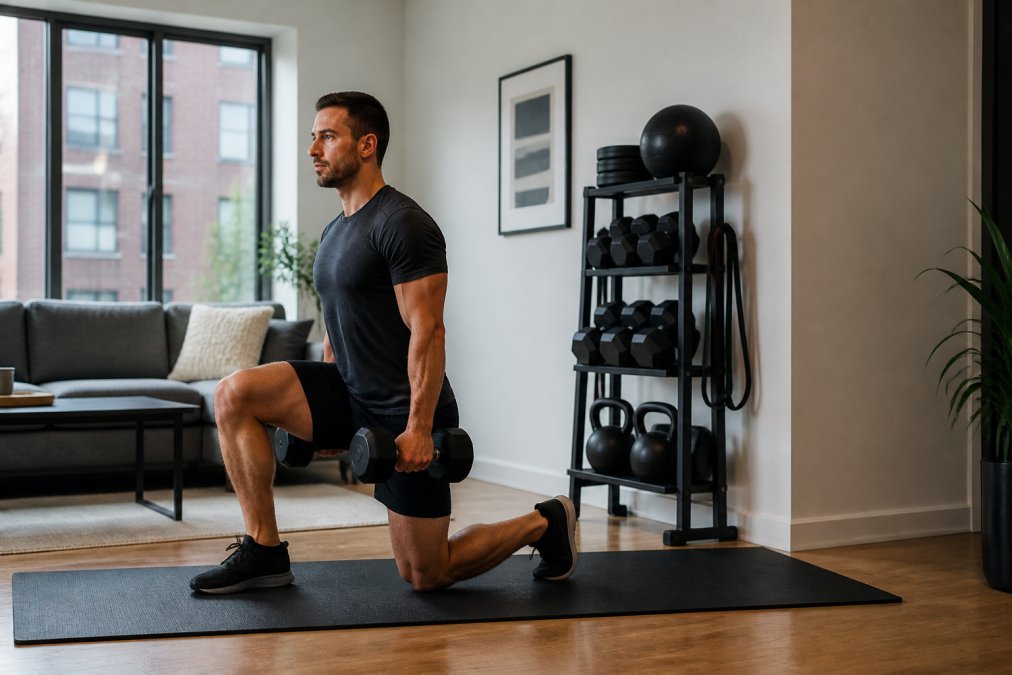
For noise, schedule heavy or high-impact work during reasonable daytime hours. If you have downstairs neighbors, avoid jumping movements entirely and opt for controlled tempos. The CDC guidelines on physical activity for adults recommend 150 minutes of moderate-intensity activity weekly, and you can hit this entirely with quiet, low-impact strength work.
Budget Tiered Setups: From $50 to $1,000
You do not need a massive budget to start, but your spending should align with your goals.
Tier 1: Under $100 (The Beginner Foundation) This tier relies almost entirely on bodyweight and minimal gear. A doorway pull-up bar is the anchor, providing access to pulling movements that are hard to replicate otherwise. Add a set of resistance bands for rows and shoulder work. This setup supports a solid full-body routine but will limit lower-body loading.

Tier 2: $100 to $400 (The Intermediate Upgrade) Here, you introduce adjustable dumbbells, which unlock the majority of strength exercises. A pair in this range typically covers 5 to 50 pounds, sufficient for most pressing and rowing movements. Pair this with the pull-up bar and a push-up board to target different angles.
Tier 3: $400 to $1,000 (The Serious Home Gym) This budget allows for a dedicated foldable weight bench and a stronger adjustable dumbbell set with a higher maximum weight. You can now perform heavy presses, seated rows, and split squats with proper support. This tier represents a complete gym that handles hypertrophy-focused training for years.
Common Mistakes That Stall Progress in Small Gyms
The most frequent error is neglecting lower body training because squats and deadlifts feel awkward in tight quarters. Bulgarian split squats and single-leg Romanian deadlifts are just as effective for building leg mass and require almost no space. However, the deeper issue is a failure to apply progressive overload systematically when you lack a heavy barbell.
Mistake 1: Treating Bodyweight Movements as a Dead End
Many assume that once push-ups and split squats get easy, you need a rack. This is false. The principle of mechanical disadvantage allows you to add infinite difficulty without adding weight. For push-ups, elevate your feet, elevate one arm, or perform archer push-ups. For squats, perform pistol squats or shrimp squats, which load a single leg through a long range of motion.
Mistake 2: Ignoring Time Under Tension (Tempo)
When you can't add weight, you can add time. A 3-second lowering phase on a goblet squat or a Romanian deadlift dramatically increases time under tension, a primary driver of hypertrophy. A common pattern is to rush reps, using momentum to complete a set. In a small space, you have the advantage of no distractions; use it to slow down.
Mistake 3: Buying Equipment Without a Progression Plan
Purchasing a random collection of gadgets leads to clutter and confusion. The real question is not "What equipment should I buy?" but "What is my progression path for the next 12 months?" If you buy a 50-pound adjustable dumbbell set, you need a plan for how you will make 50 pounds feel heavier.
Mistake 4: Failing to Log Micro-Loading
Finally, many lifters fail to track their progress. Without a log of weights, reps, and sets, you cannot apply progressive overload effectively. The data-driven approach starts with writing down your numbers, which turns a workout from a random activity into a targeted intervention. Reviews in the Journal of Strength and Conditioning Research consistently show that structured, progressive programs outperform unstructured training in both strength and muscle size. But in a small space, the increments are often smaller. You might only add 2.5 pounds to a movement, or you might just add one rep. Logging these micro-loads is the only way to see the long-term trend.
Conclusion: Start Small, Train Smart
The best space saving strength training routines do not require compromise on results; they require a smarter approach to programming and equipment.
Start with one or two key pieces of equipment and a simple plan. As you master the movements and outgrow the weights, add to your setup deliberately. For a curated selection of compact home gym equipment that supports this exact approach, explore the range at PureFitnessWarehouse.com. From portable barbell sets to foldable benches, the right tools help you train harder and recover smarter.
Frequently Asked Questions
What is the best space saving weight set for home use?
Adjustable dumbbells are the most effective space saving weight set because one pair replaces an entire rack of fixed weights. The Stridewell Sports Adjustable Magnetic Barbell Dumbbell uses a quick magnetic change system, so you can swap plates between sets in seconds without spin collars. For a more traditional option, the Portable Weight Barbell Set converts between dumbbell and barbell exercises while storing under a bed or in a closet. Both protect your floor and keep your workout area clear.
Can you build significant muscle with compact fitness equipment?
Yes. Muscle growth depends on progressive overload, not machine size. Compact equipment like adjustable dumbbells, a doorway pull-up bar, and a multi-function push-up board provide enough resistance to challenge your muscles through a full range of motion. The key is tracking your reps and weight week to week so you keep increasing the stimulus. A $250 adjustable dumbbell set can support years of hypertrophy training if your routine follows a structured progression plan.
How do I follow a minimalist strength training plan with just a few items?
Focus on compound movements that hit multiple muscle groups. A proven minimalist strength training plan uses three sessions per week: one for push movements (push-ups, overhead press), one for pull movements (pull-ups, rows), and one for legs (squats, lunges, Romanian deadlifts). Use a doorway pull-up bar for back and biceps, adjustable dumbbells for pressing and squatting, and an abdominal wheel for core. Increase reps or weight every session to keep progressing.
How do I protect my floor and keep workouts quiet in an apartment?
Use a thick rubber mat under your workout area to protect flooring and absorb impact from dropped weights. For noise reduction, avoid dropping weights entirely by controlling the eccentric phase of each rep. Choose rubber or urethane-coated plates instead of metal ones, since they clang less. If you live above someone, schedule workouts at reasonable hours and consider a pull-up bar with foam padding to avoid damaging your door frame.
Building strength in a small space is a challenge of design, not of willpower. Get started with PureFitnessWarehouse.com and build a routine that fits your space and your ambition.