

Table of Contents
- What Separates a High Quality Weight Bench From a Cheap One
- Adjustable Weight Bench Features That Actually Matter
- Flat vs Adjustable Weight Bench: Which Fits Your Training
- Weight Bench Weight Capacity: How to Read the Rating
- Weight Bench Dimensions and Fit for Your Body and Space
- Frame Construction, Stability, and Long-Term Durability
- Frequently Asked Questions
Last Updated: October 13, 2026
What Separates a High Quality Weight Bench From a Cheap One
Walk into any home gym and you can spot the difference between weight benches in five seconds. A high quality weight bench holds its position under load, its pad stays firm through the final rep, and its frame does not shift when you rack a heavy dumbbell.

A high quality weight bench is a strength-training platform built around four measurable specs: frame steel thickness, verified load capacity, stable footprint, and a pad that keeps its shape. Everything else, from upholstery stitching to adjustment gears, supports those four.
This guide from PureFitnessWarehouse.com breaks down the essential features of high quality weight benches so you can compare specs with confidence instead of guessing from photos.
Adjustable Weight Bench Features That Actually Matter
Adjustability is where most buyers overspend or underspend. An adjustable weight bench earns its price through two things: how many positions it offers and how securely it locks into each one.
Backrest and Seat Adjustment Range
Backrest angle determines which muscle groups you can train. A bench that only offers flat and one incline position limits you to pressing movements.
Seat position matters just as much. On an incline, a fixed flat seat creates a gap between your lower back and the pad. An adjustable seat that rises with the backrest keeps your hips supported and your spine neutral.
Locking Mechanisms and Adjustment Speed
Locking mechanisms fall into three common types: pin-and-hole, ladder-style, and pop-pin with detents. Pin-and-hole systems are simple and rarely fail. Ladder-style mechanisms adjust faster but rely on tighter manufacturing tolerances.
Test the lock before you buy. A good bench locks with a firm, audible click and shows zero play when you push down on the pad. Any wobble at the joint will get worse under load.
Flat vs Adjustable Weight Bench: Which Fits Your Training
The flat versus adjustable weight bench decision comes down to one question: do you press on an incline? A flat bench is more stable, lighter, and cheaper for the same frame quality.
| Bench Type | Best For | Trade-Off | Storage |
|---|---|---|---|
| Flat bench | Heavy flat pressing, bench dips, step-ups | No incline or decline work | Fixed footprint |
| Adjustable bench | Full upper-body training, incline and decline pressing | Slightly more flex at the hinge | Often folds |
| Foldable adjustable | Small home gyms, apartment setups | Compromises on frame rigidity | Folds flat |
If your program includes incline dumbbell presses, decline work, or seated shoulder presses, an adjustable bench is the practical choice. If you train almost exclusively flat barbell work, a flat bench gives you more stability per dollar.
Weight Bench Weight Capacity: How to Read the Rating
Weight capacity ratings confuse almost everyone. A bench listed at a certain capacity is not promising that number for your body weight alone. It refers to total load.
Total Load vs User Weight
Total load is the combined weight of the user plus everything they lift. If you weigh 200 pounds and press 150-pound dumbbells, your bench needs to handle at least 350 pounds of total load, plus a safety margin.
A safety margin matters because dynamic movement adds force. Lowering a weight quickly or bouncing out of a rep briefly exceeds the static load.
New Upgraded Multi-function Weightlifting Bench, Home Abdominal Waist Fitness →
Check whether the stated capacity covers the user, the weights, or both. If the listing is unclear, ask before buying.
Weight Bench Dimensions and Fit for Your Body and Space
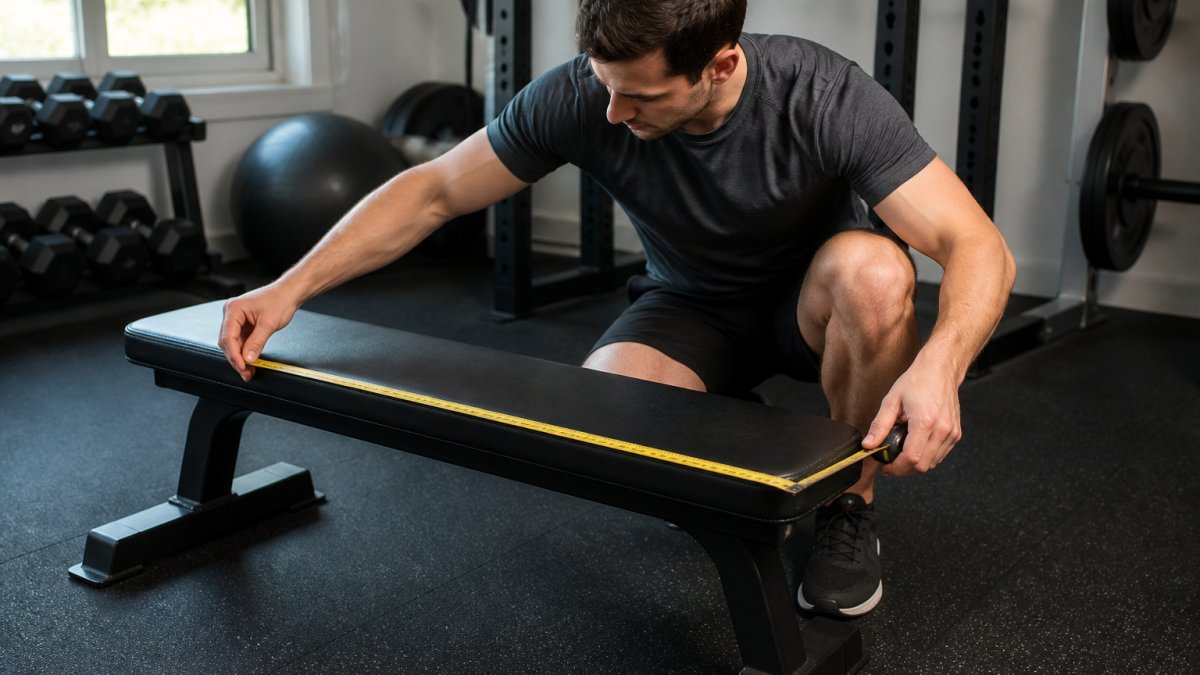
Bench dimensions decide whether a bench fits your body and your room, and most buyers check only one of the two. Published specs tell you what the bench is; they do not tell you whether it fits you.
Pad Length, Width, and Thickness
- Pad length: Most home benches run about 43 to 48 inches. A shorter pad forces your head or upper back off the edge during flat pressing; an excessively long pad can crowd the uprights of a rack.
- Pad width: Common widths fall between 10 and 12 inches. A narrower pad (closer to 10 inches) lets your shoulder blades retract and your arms travel through a full range of motion. A wider pad feels more stable at rest but can block the bottom of a dumbbell press.
- Pad thickness: Roughly 2 to 3 inches is typical. Thicker padding feels plush on day one and compresses into a groove within a year; thinner, denser padding holds its shape but offers less cushioning on heavy sets.
Fit Checks for Your Body and Lifting Style
Dimensions alone do not tell you whether a bench fits. Run these checks before you commit:
- Seated pad check. Sit on the bench with your feet flat on the floor. Your knees should bend to roughly 90 degrees with your heels down. If your feet dangle or your knees rise above your hips, the bench is too tall for your leg length.
- Flat-press head check. Lie flat and press your shoulder blades into the pad. Your head should rest fully on the pad with a small gap between the crown of your head and the end of the bench. If your head hangs off, the pad is too short for your torso.
- Shoulder-blade check. With your back flat, your shoulder blades should sit fully on the pad with room to retract. If the pad edges dig into your shoulder blades, the pad is too narrow for your frame.
- Incline hip check. Set the backrest to your typical incline. Your hips should stay in contact with the seat pad with no gap at your lower back. A fixed flat seat under a steep backrest creates that gap and shifts load onto your spine.
- Footprint check. Measure your available floor space and add clearance for loading plates, stepping around the bench, and racking dumbbells. A fixed bench can dominate a small room; a compact or foldable frame helps in apartments.
Height, Ceiling, and Rack Clearance
Measure your ceiling and rack height before buying a bench with a steep incline setting. A tall backrest at full incline can put your head uncomfortably close to a low ceiling or a wall-mounted rack. If you press inside a rack, confirm the bench pad sits low enough that the bar clears the j-hooks at your working height.
Frame Construction, Stability, and Long-Term Durability
Frame construction is where a bench either earns its price or reveals it was never worth it. Look for a steel frame with square or rectangular tubing, welded joints rather than bolted ones at load-bearing points, and a stated steel thickness. Those are the basics every buyer hears. What most guides skip is how to verify them and how to keep the bench safe years later.
Reading Frame Specs Like a Buyer, Not a Browser
- Tubing shape: Square and rectangular tubing resist twisting better than round tubing of the same wall thickness. Round tubing is common on budget benches because it is cheaper to bend and weld.
- Steel thickness (gauge): Lower gauge numbers mean thicker steel. A frame that lists gauge or wall thickness in millimeters is giving you a verifiable number; a frame that only says 'heavy-duty steel' is not.
- Joint type: Welded joints at load-bearing points (the hinge, the seat-to-frame connection, the foot plates) resist flex better than bolted joints. Bolted joints can loosen over time, which is why monthly bolt checks matter.
A Repeatable Stability Inspection Before You Lift
Stability comes from the footprint, not the frame alone. Wider feet and non-slip feet keep the bench planted during heavy lifts. A bench that rocks side to side under load raises injury risk, especially on dumbbell presses where you cannot rely on a rack for balance. Run this checklist before your first working set and again any time the bench has been moved:
- Wobble test. Place the bench on a level floor and press down firmly on each corner of the pad in turn. Any rocking means the feet are uneven, the floor is uneven, or a joint has loosened.
- Joint check. Grip the frame near the hinge and the seat connection and try to twist. Visible movement at a weld or bolt is a stop-lifting signal until it is tightened or repaired.
- Foot check. Confirm all non-slip feet are present, seated flat, and free of cracks. Missing or hardened feet are a common cause of sliding during incline pressing.
- Locking mechanism check. Set the backrest to each position you use and push down hard on the pad. A good lock holds with zero play; any wobble at the joint will get worse under load.
- Fastener check. Tighten bolts and locking pins monthly. Vibration from repeated sets loosens hardware faster than most owners expect.
Padding, Upholstery, and Long-Term Maintenance
Padding and upholstery affect how the bench feels after a year of use. Dense foam holds its shape; cheap foam compresses into a groove where your back always sits.
Seam durability is the detail most listings hide. Look for double-stitched seams along the pad edge and around any cutouts. A single-stitched seam is the first thing to split when the cover stretches over foam.
Durability also depends on how you treat the bench:
- Wipe the pad after sessions with a mild cleaner to prevent sweat from breaking down the cover.
- Check bolts and locking pins monthly and re-tighten as needed.
- Store a foldable bench in a dry space; humidity accelerates rust on chipped steel.
- Replace worn feet, pads, or locking pins rather than living with a bench that has started to move.
These habits cost nothing and add years of service.
Frequently Asked Questions
What features should I look for in a weight bench?
Prioritize a steel frame with a thickness of at least 2 mm, a weight capacity that exceeds your body weight plus the heaviest load you plan to lift, and adjustable backrest and seat positions if you want incline or decline work. Check pad width and density for comfort, and confirm the bench dimensions fit your space and body length. Non-slip feet and a stable base matter for safe lifting.
Is a flat or adjustable weight bench better for a home gym?
A flat bench is simpler, lighter, and often more stable for bench pressing and dumbbell work. An adjustable bench adds incline and decline settings, which expand your exercise options for upper chest, shoulders, and core. If you have room for only one bench, an adjustable model with a flat setting gives you the most versatility. If you mainly press flat, a dedicated flat bench may be sturdier.
How much weight should a weight bench support?
Look for a weight bench weight capacity that covers your body weight plus the weight you lift. Many quality benches rate 300 kg (about 660 lbs) or more, but always check whether the rating includes the user or only the load. For heavy lifting, choose a bench with a safety margin above your heaviest expected total. A reinforced frame and wider feet help handle heavy loads safely.
How do I choose the right weight bench dimensions for my space?
Measure your available floor space and compare it to the bench length and width. A typical adjustable bench runs 115 to 130 cm long and 40 to 60 cm wide. Ensure the bench fits under your rack or allows room for dumbbell flyes. Also consider pad width for shoulder comfort and seat height for foot placement during leg drive.