

Table of Contents
- Why Home Gym Alternatives Without Weights Work
- Household Items for Home Workouts That Add Real Resistance
- How to Build Muscle Without Weights: Progressive Overload Without Iron
- A Bodyweight Strength Training Routine You Can Run 4 Days a Week
- Bodyweight and Calisthenics Alternatives That Replace Specific Lifts
- Safety and Ergonomics of Improvised Weights
- Tools Worth Buying: Pull-Up Bars, Bands, and Suspension Trainers
- Frequently Asked Questions
Last Updated: September 13, 2026
Why Home Gym Alternatives Without Weights Work
Home gym equipment alternatives without weights work because muscle responds to mechanical tension and metabolic stress, not to iron specifically. Your body doesn't know whether the resistance comes from a barbell or a loaded backpack.
That distinction matters more than most lifters realize. Calisthenics athletes build serious upper-body mass using nothing but bars and gravity. The limiting factor is never the equipment. It's whether you can progressively increase the demand placed on the muscle.
This guide from PureFitnessWarehouse.com breaks down how to build a complete strength program using household items, bodyweight movements, and a few inexpensive tools. Below, we'll show you exactly how to load each movement pattern, how to track progress without a weight room, and where improvised setups go wrong.
Household Items for Home Workouts That Add Real Resistance
Household items for home workouts provide genuine resistance when you match the load to the movement. A gallon of water weighs roughly 8 pounds, and a full laundry detergent jug lands in a similar range (usgs.gov). Two of them in a backpack turn a bodyweight squat into a loaded squat.
The trick is choosing containers that won't rupture mid-set and handles that won't cut into your grip.
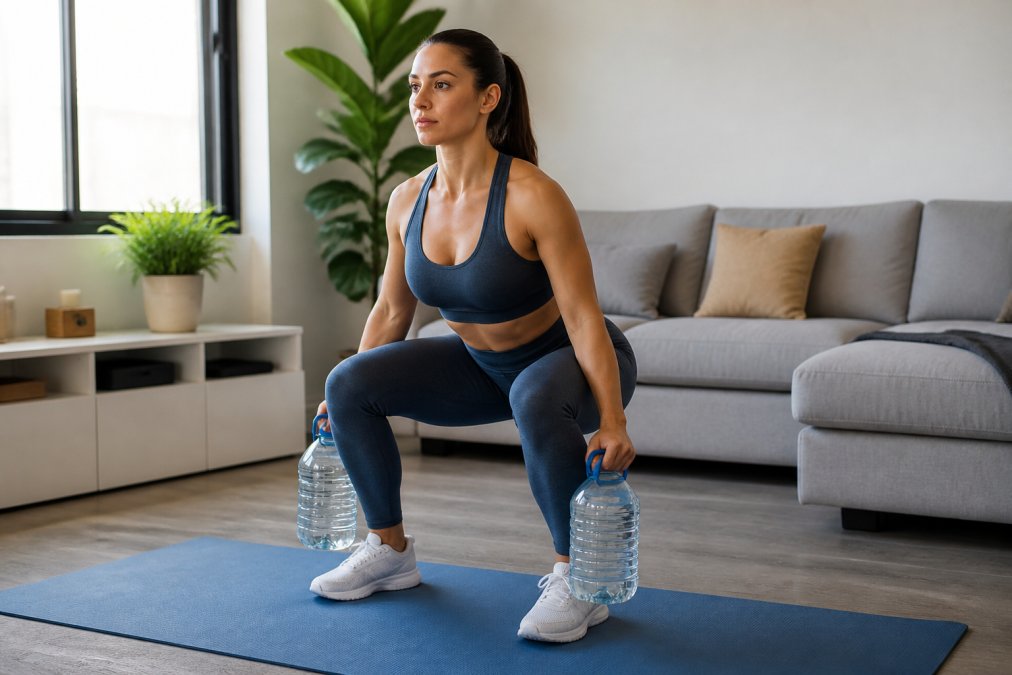
Water Jugs, Detergent Bottles, and Backpacks
Water jugs and detergent bottles work best for unilateral movements: split squats, single-arm rows, and lateral raises. Their handles give you a secure grip, and the weight is concentrated in a compact shape.
Backpacks handle the loading problem differently. Fill one with books, canned goods, or sandbags, then wear it for squats, push-ups, lunges, and step-ups. A common mistake is loading a backpack unevenly, which shifts your center of gravity and stresses one side of your spine. Pack it flat and centered.
Test every container before you train. A jug that weeps at the cap will soak your floor by set three.
Towels, Broomsticks, and Stair Edges
A towel becomes a training tool the moment you create tension with it. Loop it around a door handle and lean back for rows. Grip both ends and pull isometrically against your own resistance for biceps and grip work.
Broomsticks serve two purposes: they teach movement patterns before you load them, and they act as a lever for rotational core work. Hold one overhead during a squat to reinforce postural alignment.
Stair edges turn your staircase into a plyometric box and a calf-raise platform. Step-ups, elevated push-ups, and single-leg calf raises all live on the bottom two steps.
How to Build Muscle Without Weights: Progressive Overload Without Iron
Learning how to build muscle without weights comes down to one principle: make each session slightly harder than the last. You can add reps, add sets, slow the tempo, or increase the load in your backpack. Pick one variable per week.
Repetition range matters here. Research from the American College of Sports Medicine position stand on resistance training indicates that hypertrophy occurs across a broad loading spectrum when sets are taken close to failure. That means a hard set of 20 backpack squats can build muscle just as effectively as a set of 8 heavy ones.
Tracking Sets, Reps, and Tempo
Tempo is the variable most home trainees ignore, and it's the one that costs them progress. Write your sets as four numbers: eccentric, pause, concentric, pause. A 3-1-1-0 tempo means three seconds lowering, one second at the bottom, one second pushing up, no pause at the top.
Track every session in a notebook or app. Without a number on the bar, your log becomes the only proof that you're progressing.
| Variable | How to Increase | Weekly Target | Best For |
|---|---|---|---|
| Reps | Add 1-2 per set | +2 reps | Bodyweight movements |
| Sets | Add 1 set per exercise | +1 set | Volume accumulation |
| Tempo | Slow the eccentric phase | +1 second | Time under tension |
| Load | Add weight to backpack | +5-10% | Squats, lunges, rows |
| Range of motion | Deepen the position | +2-5 degrees | Push-ups, split squats |
A Bodyweight Strength Training Routine You Can Run 4 Days a Week
A bodyweight strength training routine works four days a week when you split pushing, pulling, and legs across separate sessions. This structure lets each muscle group recover before you load it again.
Run it Monday, Tuesday, Thursday, and Friday. Wednesday, Saturday, and Sunday are for walking, mobility, or rest.
Day 1: Push
- Backpack push-ups, 4 sets of 8-15
- Pike push-ups, 3 sets of 6-12
- Decline push-ups with feet on a stair, 3 sets of 8-12
- Towel isometric chest press, 3 sets of 30 seconds
Day 2: Pull
- Doorway towel rows, 4 sets of 10-15
- Backpack rows hinged at the hips, 3 sets of 10-12
- Towel biceps curls with self-resistance, 3 sets of 12-15
- Dead hangs from a pull-up bar, 3 sets of 20-40 seconds
Day 4: Legs

- Backpack squats, 4 sets of 12-20
- Single-leg split squats holding water jugs, 3 sets of 8-12 per leg
- Stair step-ups, 3 sets of 12 per leg
- Single-leg calf raises off a stair edge, 3 sets of 15-20
Day 5: Full-Body Circuit
- Burpees, 3 sets of 10
- Backpack lunges, 3 sets of 12 per leg
- Plank holds, 3 sets of 45-60 seconds
- Broomstick overhead squats, 3 sets of 15
Bodyweight and Calisthenics Alternatives That Replace Specific Lifts
Calisthenics alternatives replace specific lifts when you match the movement pattern and the loading demand. The bench press becomes a weighted push-up. The deadlift becomes a single-leg hip hinge. The overhead press becomes a pike push-up.
Here's how the major barbell lifts translate:
- Bench press → weighted push-ups, dips between two sturdy chairs, or a push-up board that shifts hand position to target chest, shoulders, or triceps
- Deadlift → single-leg Romanian deadlifts holding a loaded backpack, or hip hinges with a heavy jug
- Overhead press → pike push-ups, handstand holds against a wall, or an adjustable spring arm exerciser for the triceps and chest
- Barbell row → towel rows anchored in a doorway, or one-arm backpack rows
- Squat → backpack squats, Bulgarian split squats, or stair step-ups
- Curl → towel curls, jug curls, or resistance band curls with a door anchor
Compound movements still matter. A push-up plus a row plus a squat covers the same ground as a bench, a row, and a back squat. You're just rearranging the load.
Safety and Ergonomics of Improvised Weights
The safety and biomechanics of improvised weights come down to three things: grip security, load symmetry, and joint alignment. Get any of them wrong and you're training around an injury instead of through a program.
Grip strength fails first. A jug with a narrow handle will slip before your legs give out, so wrap a towel around it or wear gloves. When a container's handle digs into your palm, you'll unconsciously shift your wrist, which transfers stress to the elbow.
Load symmetry matters for anything you carry on your back or hold at your sides. A backpack with a 20-pound plate on one side pulls your torso into a lean. Pack it flat and check the mirror before your first set.
Postural alignment under load is the third piece. When you hold weights at your sides during a squat, your shoulders round forward and your upper back loses tension. Set your shoulder blades down and back before every rep, and keep the load close to your body.
Tools Worth Buying: Pull-Up Bars, Bands, and Suspension Trainers
A few inexpensive tools expand what bodyweight training can do, and they cost less than a single pair of adjustable dumbbells. The CDC physical activity guidelines for adults recommend at least two sessions of muscle-strengthening activity per week, and these tools make those sessions easier to program.
A pull-up bar unlocks vertical pulling, which is nearly impossible to replicate with household items. The Sports Products Fitness Equipment Indoor Pull-Up Bar is built from steel pipe and handles pull-ups, chin-ups, and hanging leg raises. At $54.99, it's the single highest-value addition to a home setup because it opens up your entire back and grip training.
If you rent or can't drill into a wall, the ONETWOFIT Pull Up Bar for Doorway adjusts to fit door frames between 24 and 36 inches wide and supports up to 300 lbs. It ships with resistance bands, handles, and ankle straps, so it covers pulling and accessory work in one purchase. Priced at $99.07.

The 200kg Adjustable Door Horizontal Bars is the budget doorway option at $78.05, with a 200 kg load rating on the heavier frame variants.
For pulling work away from a bar, the Resistance Band Door Anchor Set turns any closed door into a cable station. It carries a 70 kg load rating, uses a foam-padded anchor that protects your door frame, and packs flat for travel. At $21.99, it's the cheapest way to add horizontal pulling volume.
Suspension training covers the gap between bodyweight and free weights. The Adjustable Suspension Training Belt supports up to 300 kg, uses industrial nylon webbing with zinc alloy buckles, and adjusts to roughly 225 cm. It converts push-ups, rows, and split squats into scalable movements by changing your body angle. Priced at $109.52.
| Tool | Price | Best For | Load Rating |
|---|---|---|---|
| Sports Products Indoor Pull-Up Bar | $54.99 | Full back and grip training | Steel pipe construction |
| ONETWOFIT Doorway Pull-Up Bar | $99.07 | Renters, includes bands | 300 lbs |
| 200kg Adjustable Door Bar | $78.05 | Budget doorway setup | Up to 200 kg |
| Resistance Band Door Anchor Set | $21.99 | Travel and apartment pulling | 70 kg |
| Adjustable Suspension Training Belt | $109.52 | Scalable full-body work | 300 kg |
Two more items round out a home setup. The Foldable Multi-Function Push-Up Board at $44.82 shifts your hand position to target chest, shoulders, or triceps, and folds flat for storage. The Adjustable Spring Twister Arm Exerciser at $56.74 adds direct resistance for forearms, triceps, and chest without any setup.

The hardest part of training without weights isn't the first week. It's week six, when your body has adapted, your motivation dips, and you need a system that keeps adding difficulty without a rack of plates. PureFitnessWarehouse.com stocks the pull-up bars, suspension trainers, and resistance band anchors that make progressive overload possible in a small space, alongside the recovery gear that keeps you training four days a week instead of two. Browse the compact home gym collection and build a setup that grows with you.
Frequently Asked Questions
What can I use as a substitute for weights at home?
Water jugs, laundry detergent bottles, and a backpack loaded with books all work as home gym alternatives. A gallon of water weighs about 8 pounds, so two full jugs give you 16 pounds of resistance for squats, lunges, and presses. Fill a backpack with textbooks for adjustable load on push-ups or rows. Towels create friction resistance for isometric holds, and a sturdy chair or stair edge handles dips and step-ups.
Can I build muscle at home with no weights?
Yes. Muscle growth responds to mechanical tension and progressive overload, not the type of resistance. Bodyweight movements like pull-ups, dips, push-up variations, and single-leg squats build real strength when you increase difficulty over time. Add load with household items for home workouts, slow the tempo, or reduce rest between sets. Track your reps and sets so you can add volume week over week.
Are household items safe to use for strength training?
They can be, with limits. Check that containers are sealed and won't leak, and grip them with both hands. Avoid glass, anything with sharp edges, and items over 30 pounds held overhead. A backpack worn on your back is safer than a jug held at arm's length because the load sits closer to your spine. For pulling movements, a door anchor set rated to 70kg gives you a secure attachment point instead of tying bands to furniture.
How do I increase resistance without using dumbbells?
Add reps first, then add load. Move from a two-leg squat to a single-leg squat, elevate your feet during push-ups, or slow the lowering phase to three seconds. Household items for home workouts let you add weight incrementally: a half-full jug, then a full one, then two. Resistance bands and suspension trainers let you adjust tension by changing your body angle or shortening the strap.
What is the most effective way to train at home without equipment?
Run a full-body circuit three to four times a week built on compound movements: push-ups, rows, squats, hinges, and carries. Keep reps in the 8-15 range for strength and 15-25 for endurance. Track every set so you know when to add difficulty. A pull-up bar and a resistance band door anchor expand your options for back and arm work that bodyweight alone struggles to load.