

Table of Contents
- How Long Does Pre-Workout Take to Kick In?
- What Speeds Up or Slows Down Absorption
- How Long Does Pre-Workout Last?
- The Best Time to Take Pre-Workout for Your Schedule
- Common Pre-Workout Side Effects and How to Manage Them
- Stimulant vs. Stimulant-Free Formulas: Which Kicks In Faster?
- Common Mistakes That Delay Your Pre-Workout Kick-In
- Frequently Asked Questions
Last Updated: September 18, 2026
How Long Does Pre-Workout Take to Kick In?
Most pre-workout supplements take 30 to 60 minutes to kick in. This window is the standard for how long does pre-workout take to kick in across nearly every formula on the market. At PureFitnessWarehouse.com, we see this question constantly from athletes tracking their training data.
The timeline matters because it decides when you start warming up. Take your scoop too late and you'll be midway through your first set when the energy hits. Take it too early and the surge fades before your heaviest lift.
Below, we break down exactly what controls that clock, so you can time your scoop to the minute.
The 30-60 Minute Window Most Formulas Follow
Pre-workout is a powdered supplement taken before training to boost energy, focus, and blood flow. Its active ingredients need time to move through your stomach and into your bloodstream.
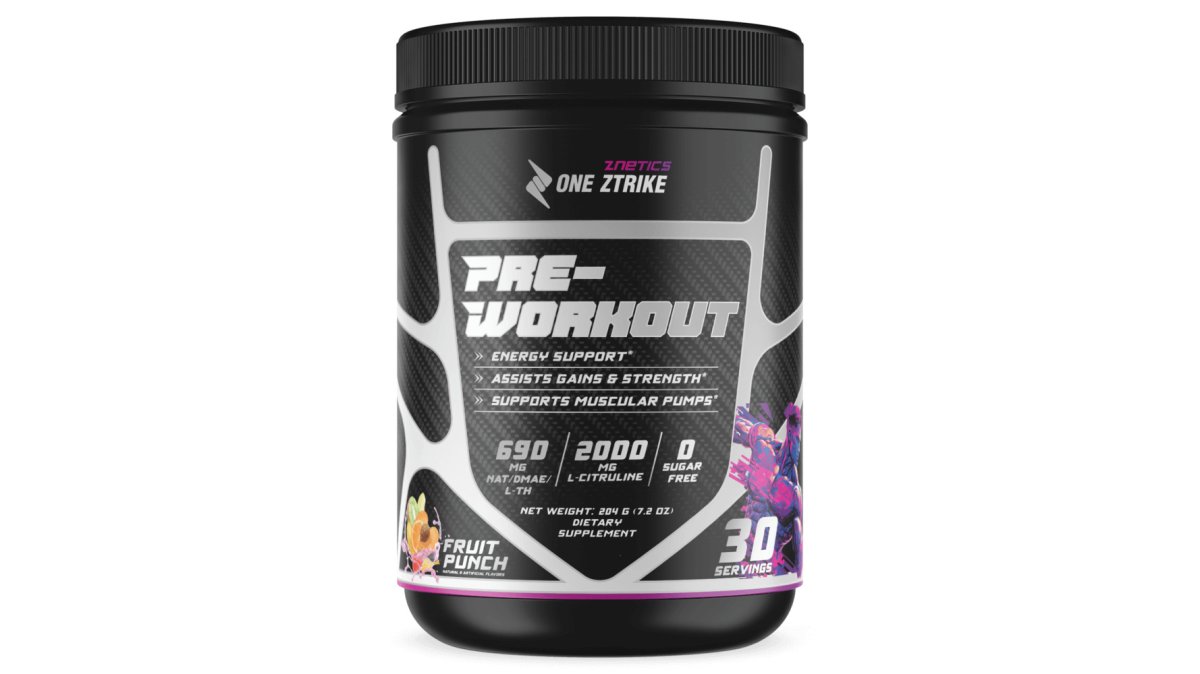
Caffeine, the main driver in most formulas, peaks in your blood roughly 30 to 60 minutes after you drink it. That peak is when you feel the surge. Other ingredients, like L-citrulline and [nitric oxide(/products/pre-workout-fruit-punch-creatine-nitric-oxide-amino-acids-one-ztrike-by-znetics) pathways | pubmed.ncbi.nlm.nih.gov], follow a similar curve.
Here's the practical version:
- 0-15 minutes: Nothing much yet. The powder is still dissolving in your stomach.
- 15-30 minutes: First hints of alertness and tingling.
- 30-60 minutes: Full effect. Energy, focus, and blood flow at their peak.
- 60+ minutes: Effects hold steady, then slowly decline.
Why Your First Scoop Feels Different From Your Fifth
Your first scoop often hits harder than your fifth. That's not your imagination.

Caffeine sensitivity drops as your body adapts to regular doses.
What Speeds Up or Slows Down Absorption
Absorption rate is the speed at which your body pulls ingredients into the bloodstream. Several things change that speed, and most of them are under your control.
Empty Stomach vs. Full Meal: The 15-Minute Difference
An empty stomach speeds absorption by roughly 15 minutes compared to a full meal. Food slows the rate at which your stomach empties into the small intestine, where most absorption happens.
So the math looks like this:
- Empty stomach: Kick-in around 20-40 minutes.
- Light snack: Kick-in around 30-50 minutes.
- Full meal: Kick-in around 45-75 minutes, sometimes longer.
Caffeine Sensitivity and Body Weight
Caffeine sensitivity varies widely from person to person. Some people feel 100 mg within 15 minutes. Others need double that to notice anything.
How Long Does Pre-Workout Last?
Pre-workout effects typically last 2 to 3 hours, with the strongest window in the first 90 minutes. After that, energy and focus taper off.
The Best Time to Take Pre-Workout for Your Schedule
The best time to take pre-workout is 30 minutes before you start training, adjusted for your stomach contents and sensitivity.
Use this timing table to match your schedule:
| Your Situation | When to Take It | Expected Kick-In |
|---|---|---|
| Early morning, empty stomach | 20-30 min before | 20-40 min |
| After a light snack | 30-40 min before | 30-50 min |
| After a full meal | 45-60 min before | 45-75 min |
| High caffeine sensitivity | 40-60 min before | 40-60 min |
| Stimulant-free formula | 20-30 min before | 20-40 min |
Common Pre-Workout Side Effects and How to Manage Them
Most pre-workout side effects are mild and tied to dose. The tingling sensation, called paresthesia, comes from beta-alanine (pubmed.ncbi.nlm.nih.gov). It's harmless and fades within an hour.
Other common effects:
- Jitters or racing heart: usually too much caffeine. Cut your scoop in half.
- Stomach upset: often from drinking it too fast or on a full stomach. Sip it slowly.
- Crash after training: a sign of a sugar-heavy or poorly dosed formula. Look for sugar-free options.
- Trouble sleeping: take it earlier or switch to stimulant-free.
Stimulant vs. Stimulant-Free Formulas: Which Kicks In Faster?
Stimulant-free formulas often kick in slightly faster because they skip the caffeine load that can slow stomach emptying at high doses. But the difference is small, usually under 10 minutes.
Common Mistakes That Delay Your Pre-Workout Kick-In
The biggest mistake is taking your scoop and immediately starting to lift. The ingredients haven't reached your bloodstream yet. But the more common, and more fixable, problem is mistiming the scoop relative to your session. Here's how to diagnose what went wrong and what to do about it.
Mistakes That Push the Kick-In Later
- Drinking it with a heavy meal. Food slows absorption by 15 minutes or more. Fat and fiber are the slowest combination.
- Using too little water. A thick mix empties your stomach slower. Use 8-10 oz.
- Taking it on a full stomach of fiber and fat. The slowest possible combo.
- Ignoring your caffeine sensitivity. A dose that works for a 220-pound lifter may overwhelm a 130-pound beginner.
- Stacking multiple stimulants. Coffee plus pre-workout plus an energy drink pushes past useful dosing and can paradoxically blunt focus.
- Sipping it slowly over 30 minutes. If you nurse your shaker, your "kick-in clock" starts when you finish, not when you start.
Mistakes That Make It Hit Too Early
- Taking it on a truly empty stomach and then waiting 45 minutes. You'll peak before you touch a barbell.
- Using a high-stim formula before a short warm-up. The surge arrives during your mobility work, not your working sets.
- Drinking it, then getting stuck in traffic or a long phone call. The window opens and closes without you.
What to Do If You Took It Too Late
This is the scenario most articles skip. You took your scoop, and 10 minutes later you're still lacing your shoes. Your session starts in 5 minutes. What now?
- Don't take a second scoop. Doubling caffeine won't speed absorption, it just stacks side effects on top of the first dose.
- Start with a longer, lower-intensity warm-up. By the time you finish 10-15 minutes of easy cardio and dynamic stretching, the caffeine curve will have caught up to you.
- Front-load your heaviest sets at the 30-45 minute mark. If you know your peak is coming, don't waste it on accessory work.
- Save the pump-focused work for later. Citrulline and nitrate peaks arrive around 60-90 minutes, so isolation and hypertrophy work actually lines up well with the back half of your session.
What to Do If You Took It Too Early
You took your scoop 90 minutes ago and the buzz is fading before your first working set.
- Don't re-dose caffeine. You'll push the active window into your sleep.
- Lean on non-stimulant tools. A short rest-pause set, a caffeine-free pump product, or simply a longer rest between heavy sets can carry you through.
- Adjust next time. If your warm-up reliably runs 20 minutes, take your scoop 10 minutes later than you did today.
The 30-60 minute window is a range, not a rule. Your stomach contents, body weight, and caffeine sensitivity shift it. Track your own kick-in time for two weeks and you'll dial in your exact pre-training window, and you'll know exactly what to do when a session goes sideways.
Frequently Asked Questions
Does pre-workout kick in faster on an empty stomach?
Yes. Taking pre-workout on an empty stomach typically means you feel it within 15-30 minutes because there is no food competing for digestion. A full meal can push that window to 45-60 minutes. If you train early in the morning, a light snack like a banana 30 minutes before your scoop gives you fuel without slowing absorption. The trade-off is that empty-stomach dosing can intensify the tingling from beta-alanine and the caffeine jolt, so start with half a scoop if you are new to pre-workout supplements.
How do I know if my pre-workout is actually working?
You will notice a gradual lift in energy, mental focus, and the urge to start moving within 30-40 minutes. Some people feel a tingling sensation (paresthesia) from beta-alanine, which is a sign the formula is active but not a requirement for effectiveness. If you feel nothing after 45 minutes, your dose may be too low, your caffeine tolerance may be high, or the product may be underdosed. Try a different formula or take a week off caffeine to reset sensitivity.
Can you sleep after taking a pre-workout?
Caffeine has a half-life of roughly 5-6 hours, meaning half the caffeine is still in your system 5-6 hours after your scoop. If you take pre-workout at 6 PM, about 100 mg of a 200 mg dose could still be circulating at midnight. For most people, training after 5 PM with a caffeinated pre-workout disrupts sleep quality. Switch to a stimulant-free formula for evening sessions, or move your workout earlier if sleep is a priority.
What happens if you take pre-workout too late in the day?
Taking pre-workout too late often means you lie awake despite feeling physically tired. The central nervous system stays stimulated, which delays sleep onset and reduces deep sleep. One late dose will not ruin you, but repeated late dosing can hurt recovery, workout performance, and mood. If your only training window is evening, choose a stimulant-free option with ingredients like l-citrulline for blood flow and pumps without the caffeine load.
Timing your pre-workout well is one of the simplest ways to get more from every session. PureFitnessWarehouse.com carries a curated range of pre-workout formulas, wearable trackers, and recovery gear so you can match your supplement to your training data. Our catalog covers energy, focus, and recovery in one place, backed by products chosen for performance. Get started with PureFitnessWarehouse.com and time your next scoop to the minute.