

Table of Contents
- Why Natural Cleaning Protects Your Mat and Your Practice
- How Often to Clean Yoga Mats: Daily Wipes vs. Deep Cleans
- Best Natural Yoga Mat Cleaner Recipe (3 Ingredients)
- Step-by-Step Deep Cleaning Process for Every Mat Material
- How to Dry a Yoga Mat Properly Without Warping or Mildew
- Materials to Avoid: Harsh Chemicals That Break Down Your Mat
- Post-Cleaning Grip Restoration and Storage Tips for Mat Longevity
- Frequently Asked Questions
Last Updated: September 10, 2026
Why Natural Cleaning Protects Your Mat and Your Practice
Learning how to clean and maintain yoga mats naturally comes down to one principle: match the cleaner to the material. Harsh disinfectants strip the surface that gives a mat its grip, while gentle, pH-neutral solutions lift sweat and oils without destroying the top layer.

Here's the counterintuitive part. A mat that smells clean isn't necessarily clean. Many conventional wipes leave a surface residue that feels fine for a week, then turns tacky as it traps dust and dead skin cells. That residue is also why so many practitioners complain their mat gets slippery over time. Natural cleaning avoids the problem at the source.
The routine below covers daily maintenance, deep cleaning, and drying, plus the material-specific details most guides skip. You'll also learn why the wrong cleaner can quietly destroy a $100 mat in a single season.
How Often to Clean Yoga Mats: Daily Wipes vs. Deep Cleans
The short answer: wipe your mat after every session and deep clean it every one to two weeks, more often if you sweat heavily or practice hot yoga (peer-reviewed research).
Daily wiping handles the immediate problem, sweat, oils, and bacteria sitting on the surface. A quick pass with a diluted spray and a microfiber cloth takes under a minute and prevents odors from setting in.
Deep cleaning goes further. It addresses buildup in the mat's texture, the grooves and pores that a surface wipe never reaches. Think of it as the difference between rinsing a dish and actually washing it.
| Frequency | Method | Time Needed | What It Removes |
|---|---|---|---|
| After every session | Diluted spray + microfiber wipe | Under 1 minute | Surface sweat, oils, light bacteria |
| Weekly | Deeper spray-down + air dry | 10-15 minutes | Accumulated residue, odors |
| Every 1-2 weeks | Full submerge or heavy wipe + dry | 30-60 minutes | Embedded grime, mildew risk |
| Monthly | Inspect for degradation | 5 minutes | Cracks, flaking, loss of grip |
A common mistake is over-cleaning with strong solutions. More frequent deep cleans with harsh products accelerate breakdown faster than skipping a week ever would.
Best Natural Yoga Mat Cleaner Recipe (3 Ingredients)
The best natural yoga mat cleaner recipe uses three ingredients: distilled water, white vinegar, and a few drops of tea tree oil. This combination cleans, deodorizes, and provides mild sanitization without leaving residue or damaging the mat surface.
Here's the base ratio:
- 1 cup distilled water
- 1/4 cup white vinegar
- 3-5 drops tea tree oil
Distilled water matters more than people realize. Tap water carries minerals that leave a film on the mat over time, especially in hard-water areas. That film is a magnet for grime.
The Vinegar and Water Base Spray
White vinegar is mildly acidic, which helps break down the alkaline salts in sweat. It also creates an environment where mildew and odor-causing bacteria struggle to thrive. Diluted properly, it won't harm most mat materials.
Skip the vinegar entirely on cork and natural rubber. Those materials are porous and can absorb the acidity, which dulls the surface over repeated use. For those mats, distilled water alone with a drop of castile soap is the safer base.

Adding Tea Tree Oil or Other Essential Oils
Tea tree oil is the workhorse here because it's naturally antimicrobial (peer-reviewed research). Essential oils like lavender or eucalyptus add scent and mild antibacterial properties, but they're optional.
Two rules keep oils from causing problems. First, never apply undiluted oil directly to the mat, as concentrated oils can degrade rubber and leave permanent stains. Second, keep the total to a few drops per bottle. More isn't better.
If you want a fragrance-free option, tea tree alone does the job without a lingering scent.
Step-by-Step Deep Cleaning Process for Every Mat Material
Deep cleaning a yoga mat takes about 30 to 60 minutes total, most of it drying time. The process is the same in principle, but the material dictates how wet you can safely get the mat.
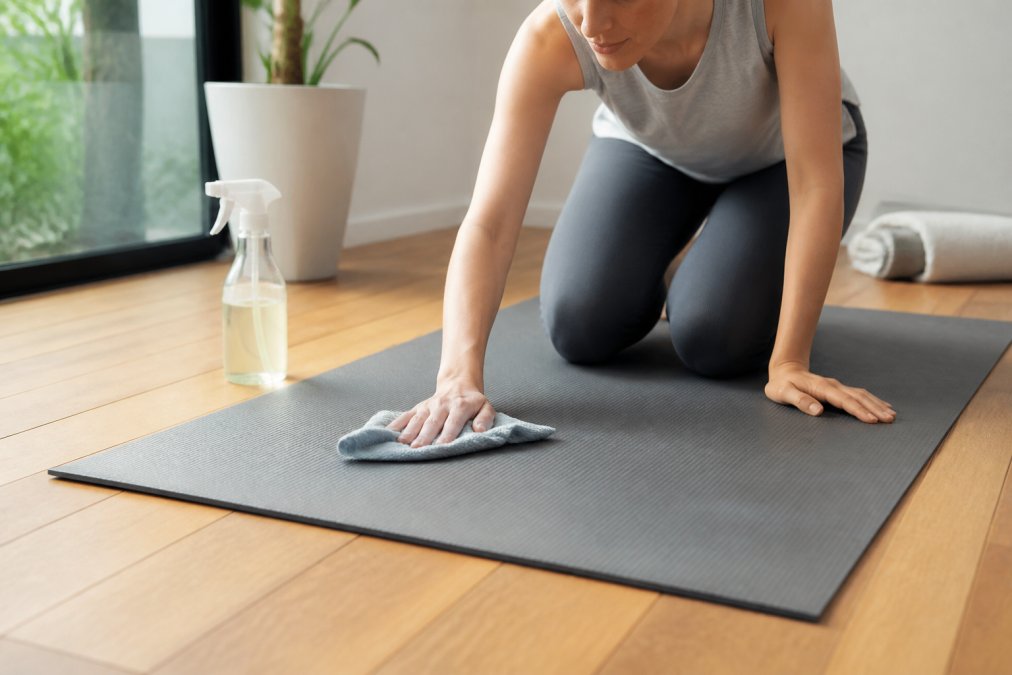
- Roll out the mat flat in a well-ventilated space, away from direct sunlight.
- Mix your cleaner using the recipe above.
- Wipe down the top surface with a damp microfiber cloth, working in the direction of the mat's texture.
- For closed-cell mats, you can lightly spray and wipe. For open-cell mats, use a barely damp cloth.
- Rinse the cloth in clean water and wipe again to remove loosened residue.
- Flip and repeat on the underside if the mat is reversible.
- Air dry completely before rolling or storing.
Closed-Cell vs. Open-Cell Construction: What Changes
Closed-cell mats have a sealed, non-porous surface. Sweat and moisture sit on top rather than soaking in, which makes them easier to clean and more resistant to bacterial growth. A damp cloth and spray handle most of it.

Open-cell mats are porous by design. That porosity is what gives them a grippier, more cushioned feel, but it also means moisture and cleaner can seep into the material. Never submerge an open-cell mat. Wipe it with a barely damp cloth and let it breathe.
Cork and Natural Rubber: Special Care
Cork and natural rubber mats are the most sensitive to cleaning. Cork naturally resists bacteria and actually grips better when damp, so it needs very little intervention. Wipe with plain water and dry thoroughly.
Natural rubber breaks down when exposed to oils, alcohol, and prolonged moisture. Keep cleaners minimal, avoid soaking, and never leave a rubber mat rolled up while damp.
How to Dry a Yoga Mat Properly Without Warping or Mildew
The best way to dry a yoga mat is to lay it flat or hang it over a rack in a well-ventilated room, away from direct heat and sunlight. Drying is where most mats get ruined, and it's entirely preventable.
Air circulation does the work. A mat left rolled up while damp becomes a breeding ground for mildew, and the smell is nearly impossible to remove once it sets in.
- Lay the mat flat or drape it over a shower rod or drying rack
- Keep it out of direct sunlight, which fades colors and weakens rubber
- Avoid hair dryers and radiators, since heat warps the material
- Give it several hours, or overnight for thicker mats
- Never roll or store until it's completely dry to the touch
Thicker, cushioned mats hold moisture longer than thin ones, so budget extra drying time. If you can press a dry cloth against the surface and feel no dampness, it's ready.
Materials to Avoid: Harsh Chemicals That Break Down Your Mat
The chemicals to avoid are bleach, ammonia, alcohol-based sprays, and most household disinfectants. These are non-toxic to you in small doses but aggressive on mat materials, and they shorten a mat's usable life dramatically.
Here's what each one does. Bleach and ammonia attack the polymer structure, causing cracking and flaking (the CDC). Alcohol dries out rubber and strips the tacky top layer that provides grip. Standard disinfectant wipes often contain both, plus fragrances that leave surface residue.
A pH-neutral cleaner is the safe default. If a product doesn't list its ingredients, don't use it on your mat.
Post-Cleaning Grip Restoration and Storage Tips for Mat Longevity
A slippery mat after cleaning is a common complaint among practitioners, and it almost never means the mat is worn out. Grip loss has at least four distinct causes, and each one needs a different fix. Diagnosing the cause before you act is what saves the mat.
Cause 1: Soap or Oil Residue
This is the most common. A thin film of castile soap, essential oil, or cleaner left on the surface acts as a lubricant between your hands and the mat. The fix is a residue strip: wipe the entire top surface with a cloth dampened with plain distilled water, then wipe again with a dry microfiber cloth. Repeat once more if the mat still feels slick. Do not add more soap, that makes it worse.
Cause 2: Over-Drying or Heat Exposure
Rubber and TPE mats rely on a slightly tacky surface layer to grip. Direct sunlight, a hot car, or a radiator can dry that layer out and leave the mat feeling slick and shiny. Once the surface has been heat-damaged, it does not fully recover, but you can slow the decline by storing the mat away from heat and rehydrating the surface with a very light wipe of distilled water before each session.
Cause 3: Surface Contamination from Lotions and Oils
Body lotion, sunscreen, and hair products transfer to the mat during practice and bond to the surface over time. They are not water-soluble, so a water-only wipe won't lift them. A drop of castile soap in a cup of distilled water, applied with a microfiber cloth and followed by a clean-water rinse, will break the film. On PU mats, use a pH-neutral mat spray instead, since castile soap can leave its own film on that material.
Cause 4: Genuine Surface Wear
If the mat has been used heavily for a year or more and the center is visibly smoother than the edges, the tacky top layer is genuinely worn. No cleaning routine restores it. This is the point to consider a grip towel or a thin yoga rug over the mat rather than replacing it, a much cheaper fix that extends the mat's usable life by months or years.
Restoring Tackiness: What Actually Works
- Warm water rinse, a barely damp cloth with warm (not hot) distilled water can reactivate the surface layer on rubber and TPE mats.
- A day of rest, some mats, especially PU, need 24 hours after cleaning for the surface chemistry to settle. If it feels slick immediately after cleaning, wait a day before deciding it's ruined.
- Grip towel or rug, the reliable fix for genuinely worn mats, and the standard solution in hot yoga studios.
- Avoid commercial grip sprays, most contain alcohol or silicone, both of which make the long-term problem worse.
Storage That Protects Grip and Longevity
Storage is where mats quietly degrade. Three rules matter most:
- Roll with the top surface facing outward. Rolling grip-side-in traps moisture against the textured surface and compresses the tacky layer.
- Store in a cool, dry place. A hot car can reach temperatures that warp rubber and TPE permanently, this is the single fastest way to destroy a mat.
- Never store damp. Even a slightly damp mat rolled up will develop mildew within 48 hours. If you're not sure, leave it flat overnight before rolling.
A covered mat bag protects against dust and UV exposure between sessions, and it's worth the small cost for any mat over $60.
When to Repair vs. Replace
A mat is worth keeping if the surface is intact and only the grip has faded, a grip towel solves that. It's time to replace when you see cracking, flaking, a persistent smell that returns after cleaning, or a compressed, uneven surface that no longer cushions joints. Cork and natural rubber mats are biodegradable and can be composted or returned through some manufacturers' take-back programs; PVC and TPE mats are not, and should be recycled through a dedicated mat recycling program rather than thrown in the trash.
Frequently Asked Questions
What is the best natural cleaner for yoga mats?
A mix of distilled water, white vinegar, and a few drops of tea tree oil works well for most mats. For a gentler option, use castile soap diluted in water. Avoid harsh chemicals that can break down the mat surface. Always spot-test first, especially on cork or natural rubber mats.
Can I use Dawn dish soap to clean my yoga mat?
Dawn and other dish soaps are degreasers that can strip the natural oils and grip from your mat over time. If you must use it, dilute a tiny drop in a quart of water and rinse thoroughly. For regular cleaning, stick to vinegar, castile soap, or a dedicated natural mat cleaner to preserve tackiness and extend mat longevity.
How often should you deep clean a yoga mat?
Deep clean every one to two weeks if you practice daily, or monthly for lighter use. Wipe down after every session with a diluted solution to remove sweat and surface residue. If you notice odors, visible dirt, or reduced grip, it's time for a deep clean regardless of schedule.
Does vinegar damage yoga mats?
White vinegar is safe for most closed-cell mats like PVC, TPE, and NBR when diluted with water. However, it can degrade natural rubber and cork over time if used undiluted or too frequently. For those materials, use a pH-neutral cleaner or plain water with a mild soap instead. Always test a small area first.
Consistent cleaning is what separates a mat that lasts a season from one that lasts years, and the natural approach protects both your mat and your practice. PureFitnessWarehouse.com stocks mats built for exactly this kind of care, from antimicrobial cork to cushioned foam, alongside the gear and recovery tools that support every session. Browse the collection and find a mat that holds up to how often you practice.