

Table of Contents
- What a Weightlifting Belt Does for Your Back
- How to Brace With a Lifting Belt (Step by Step)
- Where the Belt Should Sit on Your Waist and Hips
- How Tight Should a Lifting Belt Be?
- Using a Weightlifting Belt for Squats
- Do Lifting Belts Help Back Pain?
- Common Mistakes and How to Fix Them
- Conclusion
- Frequently Asked Questions
Last Updated: October 15, 2026
What a Weightlifting Belt Does for Your Back
A weightlifting belt is a wide, stiff band worn around the waist during heavy training. It does not support your back on its own.

That pressure is the whole point. When you brace hard against the belt, your trunk becomes rigid. Your spine moves less under load.
At PureFitnessWarehouse.com, the same question comes up: does the belt do the work, or do you? The belt does not lift the weight.
Here is the short version:
- The belt is a tool for bracing, not a back brace.
- It works best on heavy lifts, not every set.
- Fit and position matter more than brand or price.
Get those three right and a belt becomes genuinely useful. Get them wrong and you are just wearing thick leather.
How to Brace With a Lifting Belt (Step by Step)
Bracing with a lifting belt means filling your trunk with air, then pushing your core outward in every direction against the belt while keeping your ribs down. The belt gives your muscles a wall to press into, which creates the stiffness. Most guides say "brace" and move on, but that word means nothing until you have felt it, held it through a rep, and reset it between reps.
Here is the walkthrough we give first-time belt wearers: find the air, build the pressure, hold it through a rep, and reset.
Step 1: Set Your Stance and Find the Air
Stand with your feet about shoulder-width apart. Fasten the belt snug but not crushing. Breathe into your belly, not your chest, so your stomach pushes out against the front of the belt and your shoulders barely move.
A quick check: put one hand on your stomach and one on your chest. If the chest hand rises first, you are breathing too high. Try again. Some lifters find it easier to practice this lying on their back with knees bent, one hand on the belly, before standing up.
Step 2: Build 360-Degree Pressure
Hold that air and tighten your abs like someone is about to punch you. The pressure must spread in all directions, not just forward.
A common mistake is pushing only forward, which lets the sides go soft. To feel the difference, place your thumbs on your sides just above your hip bones and brace.
Hold the brace for two or three seconds, then exhale and reset. Do this five times before touching a barbell. Once you can find pressure on all sides on command, you are ready to load the bar.
Step 3: Hold the Brace Through a Repetition
A brace that lasts one second is not a brace. The skill is keeping pressure from unrack to rep's end.
For a squat, take your air at the top, brace, walk the weight out braced, descend, and exhale only after standing up.
A useful cue: imagine your trunk as a sealed can. If air leaks out at the bottom, the can goes soft and your spine loses support. If pressure fades halfway down, you let air escape or relaxed your abs.
Step 4: Reset Between Reps
Between heavy reps, take a fresh breath and rebuild the brace. Do not carry one breath through a set of five.
On lighter sets a partial reset works. On heavy sets, treat each rep as its own event. This is where the belt earns its keep: it gives you a consistent target to push against, so your brace feels the same on rep one and rep five.
Where the Belt Should Sit on Your Waist and Hips
A lifting belt sits low, across the front of your hips and just above the hip bones. It should not ride up onto your ribs or sit down on your pelvis.
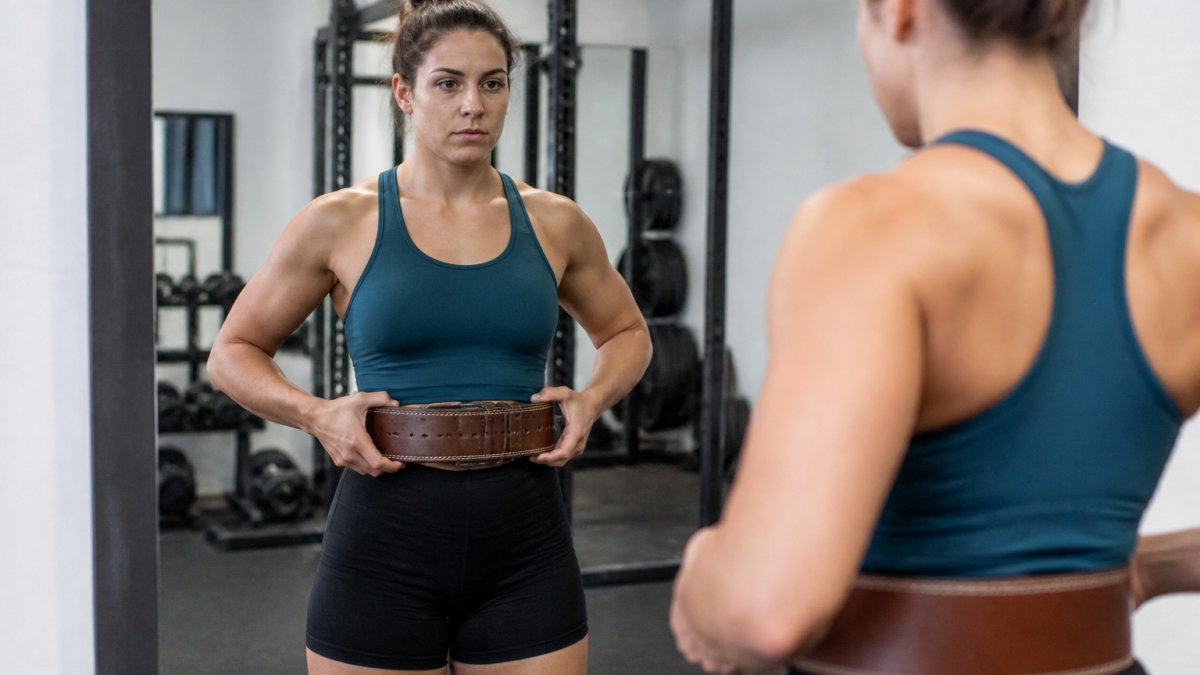
Find your hip bones with your thumbs. The bottom edge of the belt should rest at or just above that line, and the top edge lands near your belly button depending on belt width.
Adjusting for Torso Length
Lifters with a long torso often find a standard 4-inch belt sits comfortably just above the hip bones with room below the ribs. Lifters with a short torso may find it crowds the ribs in a deep squat.
Quick test: get into your squat bottom position with an empty bar. If the belt pinches your ribs or hips, move it an inch and retry. The right spot lets you breathe and brace without pain.
Adjusting for Waist Shape
A straighter waist may let the belt slide up during a squat; tightening one notch usually fixes it. A pronounced waist-to-hip ratio may cause the belt to dig into the hips at the bottom of a squat. Raise it so the bottom edge sits above the hip crease, and check that the belt is not so wide it catches the top of the thigh.
Adjusting for the Lift
Belt position is not fixed across exercises. A common pattern is:
- Squat: belt slightly higher, sitting just above the hip bones, so you can still reach depth without the belt catching your thighs.
- Deadlift: belt often one notch lower and sometimes one notch tighter, because the starting position folds you forward and a high belt can dig into the ribs.
- Overhead press: belt can sit a touch higher, since there is no hip hinge and the goal is trunk stiffness under a vertical load.
- Rows and accessory work: many lifters leave the belt off, since the loads are lighter and a belt can restrict the range of motion you are trying to train.
What Pinching or Restricted Movement Tells You
If the belt pinches at the front of the hips during a squat, it is too low or too wide for your torso.
None of these are reasons to give up on the belt. They are signals to move it an inch and retest. Most lifters find their position after two or three sessions.
Weight Lifting Belt For Gym Workout 8" Wide - Lumber Back Support All Sizes →
Belt width changes where it lands. A wider belt covers more trunk and feels stiffer; a narrower belt gives more room to bend. Neither is better, they suit different bodies and lifts.
How Tight Should a Lifting Belt Be?
A lifting belt should be tight enough to push your abs against, but loose enough to take a full breath.
Simple test: fasten the belt, then slide two fingers under the front edge. If they slide in easily, tighten one notch.
Most people over-tighten. A belt cranked down so hard you can barely breathe does not help you lift more. It just makes you dizzy.
A good rule: the belt should feel firm at rest, then noticeably tighter when you brace. That change signals you are doing it right.
Using a Weightlifting Belt for Squats
For squats, a weightlifting belt helps most above roughly 75% of your one-rep max. Below that, your own bracing is usually enough.
Set the belt before you unrack. Take your stance, breathe into your belly, brace against the belt, then walk the weight out. Keep that pressure as you descend.
A few things that help:
- Breathe at the top, not the bottom. Take your air before you descend.
- Keep your ribs down. Do not let your chest flare up as you push.
- Reset between reps if you need to. A quick breath and re-brace beats a sloppy second rep.
The belt does not fix a squat that collapses forward. If your form breaks down under load, that is a technique problem, not a belt problem.
Do Lifting Belts Help Back Pain?
Lifting belts may help some people feel more stable and confident under heavy loads, but they are not a treatment for back pain.
A belt can change how much work your back muscles do during a lift (pubmed.ncbi.nlm.nih.gov). Some lifters find it reduces lower-back strain on heavy sets; others find no difference.
What a belt cannot do is fix a weak core, poor technique, or an injury. Those need a plan, not equipment.
For most healthy lifters, a belt is a tool for heavy sets, not a daily requirement and not a substitute for building a strong trunk.
Common Mistakes and How to Fix Them
The same few mistakes show up again and again. Here is what to watch for and how to correct each one.
| Mistake | What It Looks Like | The Fix |
|---|---|---|
| Belt too high | Digs into ribs during squats | Drop it to just above the hip bones |
| Belt too tight | Cannot take a full breath | Loosen one notch and retest |
| No brace | Belt worn but abs relaxed | Inhale into belly, push out against belt |
| Wearing it for everything | Belt on for light warm-up sets | Save it for heavy working sets |
| Relying on the belt | Core feels weak without it | Train some sets belt-free each week |
A common mistake is treating the belt as a crutch. If you wear it for every set, your core never learns to brace on its own. Use it for your heavy work.
What most guides miss is that belt fit changes with the lift. A position that feels perfect for squats can feel wrong for deadlifts. Adjust it, the belt does not have to sit in the same spot for every exercise.
When you are ready to buy, look for a belt that matches your training. A basic 8-inch support belt works well for general gym training, while a stiffer leather or carbon fiber belt suits heavy powerlifting. Our NSCA guidance on lifting technique and equipment covers how support gear fits into a broader training plan.

Conclusion
Getting a belt to help your back comes down to three things: position it low, tighten it so you can still breathe, and brace hard against it before every heavy rep. Skip any one and the belt does nothing.
At PureFitnessWarehouse.com, we stock belts for every kind of lifter. From the affordable MRX 8-inch support belt at $15.99 to the Ronnie Coleman Signature Belt at $115.00 with its built-in lumbo/sacral pad, every option gives you real support where it counts.

Start with the fit, learn the brace, and let the belt do its job on the sets that matter. Shop PureFitnessWarehouse.com and train with gear built for the work.
Frequently Asked Questions
How do you properly wear a weightlifting belt?
Position the belt so its front edge sits just above your hip bones and below your ribs, covering your belly button. Fasten it snugly enough that you can still take a full breath and push your core outward against it. Wear it over a thin shirt or directly on the skin, not over thick clothing, so it stays in place during heavy lifts.
How tight should a lifting belt be?
Tight enough that you feel firm resistance when you brace, but loose enough to take a deep belly breath and fill your core. A good test: slide two fingers under the edge. If you can't, it's too tight. If your fingers slide in easily, it's too loose. Tighten it one notch at a time until you feel pressure without pinching.
Do lifting belts help back pain?
A belt can reduce strain during heavy lifts by supporting intra-abdominal pressure and trunk stability, but it is not a treatment for existing back pain. If you have an injury, talk to a healthcare provider before lifting. For healthy lifters, a belt may help you maintain proper form under load, which lowers injury risk when combined with core training.
Should beginners use a weightlifting belt?
Beginners can use a belt, but only after learning to brace without one. Spend your first few months mastering breathing and core activation on squats and deadlifts at lighter loads. Once you're lifting near 75% of your one-rep max, a belt can help you stay stable. Using one too early can mask weak bracing habits.