

Table of Contents
- Why Supplement Quality Matters for Your Fitness Goals
- Dietary Supplement Label Red Flags to Watch
- How to Check Supplement Quality Through the Ingredient List
- Third-Party Tested Supplements: What the Certifications Really Mean
- How to Choose High Quality Supplements: A Practical Checklist
- Contamination Risks and What Testing Can Detect
- Reporting Problems and Protecting Yourself
- Frequently Asked Questions
Last Updated: October 17, 2026
Why Supplement Quality Matters for Your Fitness Goals
Low quality dietary supplements can sabotage your training progress without you realizing it. A substandard product might contain half the promised ingredient, undisclosed fillers, or contaminants that derail your results.
Your body can only work with what you give it. A low quality dietary supplement wastes money and trust, and can introduce substances you didn't intend to consume. The good news: you can spot the red flags before you buy.
Dietary Supplement Label Red Flags to Watch
Vague or Exaggerated Health Claims
Legitimate supplements make modest, specific claims. Avoid products that promise to "cure," "treat," or "heal" any disease or condition.
Red flags include:
- Claims like "reverses aging" or "eliminates pain"
- Promises without any qualifying language ("supports" vs. "cures")
- Testimonials claiming dramatic transformations
The FDA doesn't approve supplements the way it approves medications (the FDA). Manufacturers can make claims, but they must be truthful and not misleading. If a label sounds too good to be true, it probably is.
Missing or Incomplete Supplement Facts Panel
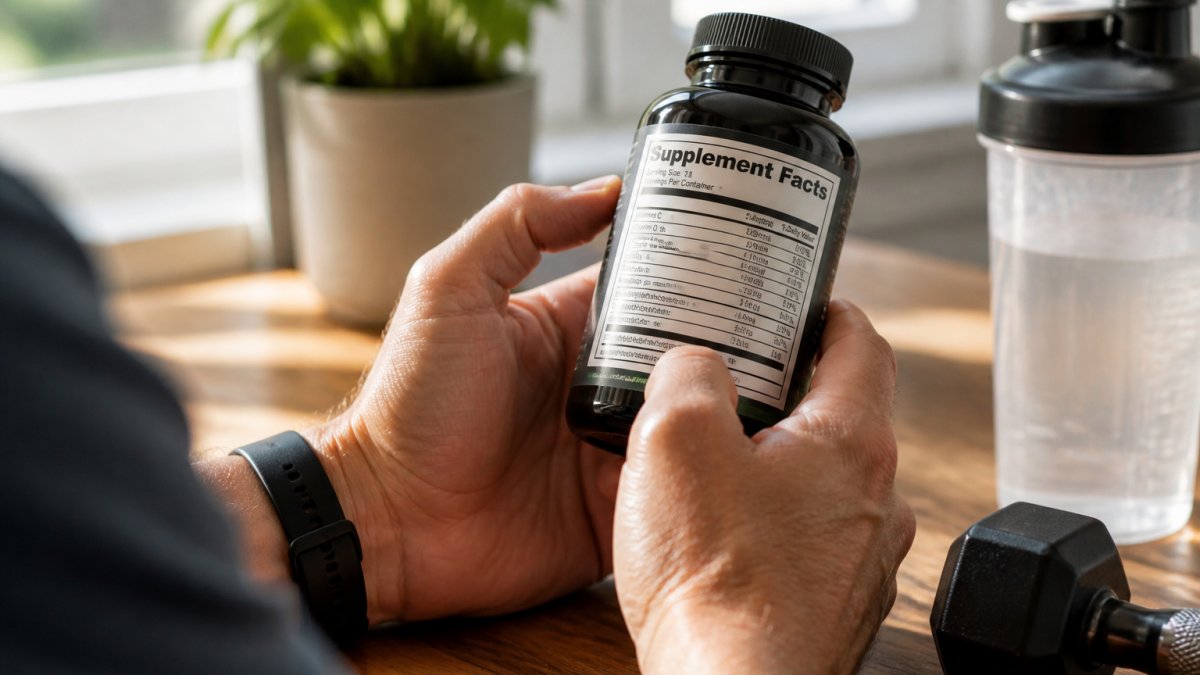
Every legitimate supplement must display a Supplement Facts panel, your window into what's actually in the bottle.
Look for:
- Serving size clearly stated
- Ingredient list with amounts in milligrams or micrograms
- "Other ingredients" section listing fillers and additives
If any of these are missing, that's a major warning sign. A low quality dietary supplement often skips details, uses tiny print, or omits the complete ingredient list entirely.
Undisclosed Fillers and Additives
The "other ingredients" section reveals what's in your supplement beyond the active compounds, where quality separates from mediocrity.
Common fillers to watch for:
- Magnesium stearate (lubricant that can impair absorption)
- Silica and talc (anti-caking agents)
- Food colorings like FD&C dyes
High-quality supplements minimize fillers. Low quality dietary supplements load up on cheap additives to cut costs, fillers that pad the capsule without adding value.
How to Check Supplement Quality Through the Ingredient List
The ingredient list tells you everything about quality. Cheap manufacturers use low-cost forms your body struggles to absorb; premium manufacturers invest in bioavailable forms that work.
Identifying Bioavailable Forms vs. Cheap Alternatives
Bioavailability matters: your body absorbs some forms of minerals and vitamins far better than others.
Compare these options:
| Ingredient Form | Bioavailability | Cost | What to Look For |
|---|---|---|---|
| Magnesium glycinate | High | Higher | Chelated or glycinate form |
| Magnesium oxide | Low | Lower | Avoid for absorption |
| Methylcobalamin (B12) | High | Higher | Active form |
| Cyanocobalamin (B12) | Medium | Lower | Synthetic form |
| Chelated minerals | High | Higher | "Chelated" on label |
| Mineral salts | Low | Lower | Oxide, carbonate forms |
PureFitnessWarehouse.com carries supplements formulated with bioavailable ingredients. Our Magnesium Glycinate, for example, uses the chelated form that your body absorbs efficiently.

Low quality dietary supplements often use the cheapest mineral forms available. Magnesium oxide costs pennies per kilogram. Magnesium glycinate costs significantly more. That price difference reflects real absorption differences your body will feel.
Spotting Proprietary Blends That Hide Dosages
Proprietary blends are a common trick: the label lists ingredients but hides exact amounts behind a "proprietary blend" label, so you have no idea how much of each ingredient you're getting.
What to look for:
- Individual ingredient amounts listed separately (best practice)
- Transparent dosing for each active ingredient
- Avoid products listing only a total blend weight
A proprietary blend might contain 1mg of the key ingredient and 999mg of cheap filler. High-quality supplements break down every ingredient with exact amounts.
Third-Party Tested Supplements: What the Certifications Really Mean
Third-party testing is where quality gets verified: independent labs confirm supplements contain what the label claims and are free from contaminants. But "third-party tested" on a label is a claim, not proof, the useful skill is verifying the testing behind it.
USP Verified, NSF Certified, and ConsumerLab Standards
These certifications carry real weight because they require ongoing testing, not a one-time pass:
USP (United States Pharmacopeia) Verified means an independent lab tested the product and confirmed:
- Label accuracy (contains claimed ingredients in claimed amounts)
- Purity standards
- No harmful contaminants
NSF Certified (including NSF Certified for Sport) indicates the product passed testing for:
- Label claim verification
- Banned substance screening (the Certified for Sport program screens for substances prohibited by major athletic organizations)
- Heavy metal testing
ConsumerLab certification verifies:
- Ingredient identity and potency
- Absence of contaminants
- Consistent quality across batches
Low quality dietary supplements often skip third-party testing entirely, leaving you with only the manufacturer's word. A certification seal is only useful if you confirm it's current and applies to the product in your hand.
How to Verify a Certificate of Analysis
A Certificate of Analysis (CoA) is the lab report proving what's in the bottle, often available from manufacturers or their website. Read it critically, a PDF with a logo is not the same as a valid test report.
Check the CoA for:
- Lab name and accreditation status. The testing lab should be independent of the manufacturer and accredited (for example, to ISO/IEC 17025). If the "lab" is the manufacturer's own in-house facility, the report is a self-check, not independent verification.
- Testing date. A CoA from three years ago says nothing about the batch you're holding. Recent is better, and the date should fall within the product's current lot.
- Lot or batch number matching your product. This is the most commonly skipped check. A CoA for Lot A does not verify Lot B. Confirm the lot number on the report matches the number printed on your bottle.
A legitimate manufacturer provides this information freely. Low quality dietary supplements make it hard to find or refuse to share their CoA, or provide a generic certificate that doesn't match your batch.
Batch-Level Verification: Why One Test Isn't Enough
A single passing test does not guarantee every bottle is clean. Ingredients arrive in lots, and testing one batch per year doesn't verify the batch you buy. The stronger practice is batch-specific testing: a CoA tied to the exact lot number on your bottle, with results for identity, potency, and contaminants. A CoA with no lot number is a marketing document, not proof.
How to Choose High Quality Supplements: A Practical Checklist
Use this checklist before buying any supplement:
- Label lists specific ingredient amounts (not proprietary blends)
- Supplement Facts panel is complete and easy to read
- Bioavailable ingredient forms used (glycinate, chelated, methylated)
- Third-party certification visible (USP, NSF, or ConsumerLab)
Contamination Risks and What Testing Can Detect
Contamination is a serious concern: manufacturing facilities vary wildly in cleanliness and quality control. Third-party testing catches problems visual inspection never would, but it's worth understanding what testing looks for and where its limits are.
What Testing Can Detect
A thorough contaminant panel typically screens for:
- Heavy metals, lead, cadmium, mercury, and arsenic. These can enter through raw ingredients, soil, or processing equipment. Lead in particular accumulates in the body over time (the CDC).
- Microbial contamination, bacteria such as Salmonella and E. coli, mold, and yeast. Herbal and botanical ingredients are especially prone to microbial issues if drying and storage are poorly controlled.
- Undeclared ingredients or pharmaceuticals, anabolic steroids, stimulants, or prescription drugs that aren't on the label. This is a particular risk in products marketed for weight loss, bodybuilding, or sexual enhancement.
- Pesticide residues, relevant for botanical ingredients grown without adequate oversight.
Low quality dietary supplements sometimes source ingredients from suppliers with minimal oversight. A batch of magnesium might contain lead; herbal products might harbor mold. Without testing, you'd never know.
What Testing Can't Tell You
Testing is powerful but not absolute. Understanding its limits keeps you from over-trusting a single result:
- Detection limits. Every test has a limit of detection. A result reported as "not detected" means below the lab's threshold, not necessarily zero. The threshold matters, a very high limit can mask a real problem.
- Sampling error. A lab tests a sample from a batch, not the entire batch. Poor mixing or uneven contamination can mean one sample passes while another portion of the same lot does not.
- Scope gaps. A panel that tests for heavy metals but not microbials, or identity but not potency, leaves blind spots. The CoA's scope tells you what was actually checked.
- Batch drift. A passing test on one lot says nothing about the next. Contamination risk is batch-specific, which is why lot-matched CoAs matter more than a single historical report.
Reducing Contamination Risk Before You Buy
You can't run your own lab test, but you can stack the odds:
- Buy products with batch-specific CoAs that match the lot number on the bottle.
- Prefer manufacturers who test every batch rather than periodically.
- Look for certifications (USP Verified, NSF Certified, NSF Certified for Sport) that require ongoing testing and facility audits.
- Avoid products marketed for dramatic results in categories with high adulteration risk (weight loss, bodybuilding, sexual enhancement) unless they carry strong third-party verification.
Our Nature's Lab Gold Six Daily Advanced Multivitamin, for instance, is formulated in a USP-audited facility.

Reporting Problems and Protecting Yourself
If you suspect a supplement caused an adverse reaction or contains something harmful, report it.
Steps to take:
- Contact the manufacturer first with photos of the product and batch number
- Report to the FDA's MedWatch program online or by phone
- Keep the bottle and any documentation of your reaction
- Note the exact date you consumed it and what happened
The FDA tracks adverse event reports. Patterns of problems trigger investigations and recalls. Your report matters.
When buying supplements, also verify the seller. Buy from reputable retailers, not random online marketplaces where counterfeit products thrive.
Low quality dietary supplements cost you money and trust.
Ready to upgrade your supplement game? Our Magnesium Glycinate ($17.99-$19.99) and Nature's Lab Gold Six Daily Advanced Multivitamin ($39.99) are available.

Frequently Asked Questions
How can you tell if a dietary supplement is low quality?
Low quality dietary supplements often lack third-party testing certifications, contain vague ingredient forms, include excessive fillers, or make unsubstantiated health claims. Check for missing dosage information, proprietary blends that hide individual ingredient amounts, and absence of USP Verified or NSF Certified marks. Quality supplements list specific ingredient forms (like methylcobalamin for B12 or magnesium glycinate), include complete Supplement Facts panels, and come from manufacturers willing to share certificates of analysis upon request.
What are the most common red flags on a supplement label?
Watch for claims like 'cures,' 'treats,' or 'prevents disease,' which violate FDA regulations. Missing serving sizes, unclear active ingredient amounts, and proprietary blends are major concerns. Absence of third-party testing marks, artificial colors or sweeteners listed without purpose, and manufacturer contact information that's difficult to find also signal low quality. Nature's Lab Gold Six Daily, for example, clearly lists over 90 ingredients with bioavailable forms.
Does third-party testing guarantee a supplement is safe or effective?
Third-party testing verifies that a supplement contains what the label claims and screens for contamination, but it does not guarantee the supplement will work for your individual needs. USP Verified, NSF Certified, and ConsumerLab testing confirm purity, potency, and absence of heavy metals or undeclared ingredients. However, effectiveness depends on ingredient quality, dosage, your body's absorption, and whether the supplement addresses your specific deficiency. Testing is a critical quality indicator, not a promise of personal results.
How do I verify what ingredients are actually in a supplement?
Request the certificate of analysis from the manufacturer, reputable companies provide this freely. Check the Supplement Facts panel for specific ingredient forms (methylated vitamins, chelated minerals like magnesium glycinate) and exact dosages. Look for third-party testing seals from USP, NSF, or ConsumerLab on the label. Avoid proprietary blends that list ingredients without individual amounts. Products like BLACKLABEL Magnesium Glycinate clearly state the form and amount per serving, making verification straightforward.