

Table of Contents
- Assess Your Space and Equipment
- Home Gym Storage Ideas for Every Corner
- How to Hide Workout Equipment in Your Living Room
- No-Drill Workout Equipment Storage Solutions
- Small Space Home Gym Organization by Equipment Type
- Safety, Weight Limits, and Damage Prevention
- Keeping Your Neighbors Happy: Noise and Floor Protection
- Frequently Asked Questions
Last Updated: October 4, 2026
Assess Your Space and Equipment
When you need to store workout equipment small apartments, it requires honest inventory work first. Before you buy a single resistance band or dumbbell, measure your actual available space and list what you already own.
Walk through each room and note dimensions of closets, under-bed clearance, corner spaces, and wall surfaces. Document ceiling height where you might mount items. This 15-minute exercise saves weeks of frustration later.
Audit your current equipment by writing down dimensions and weight. A standard yoga mat is roughly 24 inches wide by 68 inches long; hex dumbbells take up less space than rounded ones; resistance bands roll into a compact bundle. Understanding what you have makes it easier to find homes for everything.

Home Gym Storage Ideas for Every Corner
Small apartments hide storage potential in overlooked places. Think vertically and use dead space strategically. Map your apartment layout first, then assign equipment zones based on access frequency and space constraints.
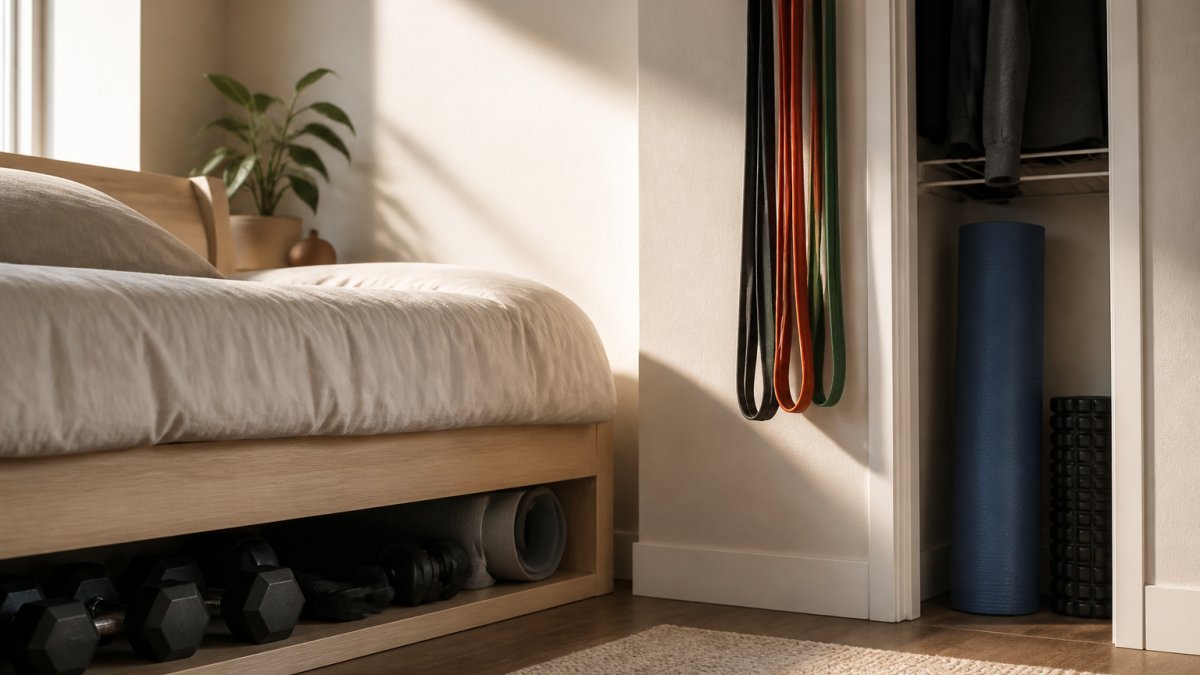
Closet and Under-Bed Storage
Closets work well when you need to store workout equipment small apartments. A standard bedroom closet (24 inches deep by 36 inches wide) fits a vertical yoga mat rack, small dumbbell set, and resistance bands.
Measure your closet's interior dimensions and note obstructions before purchasing storage solutions. A rolled yoga mat (24 inches wide × 4 inches diameter) fits easily in a corner; three hex dumbbells occupy roughly 12 inches of floor space when stacked.
Under-bed storage works for flat items like yoga mats, foam rollers, and resistance bands. Measure your bed's clearance first, most beds sit 8-12 inches high. Sliding storage containers keep dust off equipment and make retrieval fast.
Do not stack heavy dumbbells under the bed; the weight concentrates on a small area and can damage flooring, the bed frame, or slats. Reserve under-bed space for lightweight, flat items only: yoga mats, foam rollers, resistance bands, and jump ropes.
End Tables and Hidden Furniture Storage
End tables with shelves or drawers provide dual-purpose storage. Keep hand grippers, jump ropes, or resistance bands in drawers to keep equipment accessible and hidden. Most standard nightstands support 10-20 lbs, enough for resistance bands and jump ropes.
Ottomans with hidden storage compartments store lighter equipment and double as step platforms. Verify interior dimensions accommodate your equipment; most ottomans are 18-24 inches wide and 12-18 inches deep.
Corners and Crevices
Corners are underutilized storage zones. A tension rod (28-120 inches adjustable) holds rolled yoga mats or resistance bands without wall damage. Tall, narrow shelving units fit corners without blocking traffic; a 72-inch unit occupies only 12-18 inches of floor space.
Tuck a yoga mat or foam roller vertically into gaps between walls and furniture (typically 4-8 inches). Wall-mounted hooks in corners hold jump ropes, resistance bands, or hand grippers. Adhesive hooks rated for 5-10 lbs work for light equipment; verify your wall type before applying, as adhesive performs poorly on heavily textured surfaces.
Creating a Measurement Checklist
Before purchasing storage solutions or equipment, create a simple checklist of your apartment's dimensions:
- Closet interior width, depth, and height (measure from floor to the lowest obstruction)
- Under-bed clearance (measure from floor to bed frame bottom)
- Corner floor space (measure the width and depth of each unused corner)
- Wall space available for mounting (measure linear inches of clear wall between furniture and fixtures)
- Doorway widths (for over-the-door organizers; standard interior doors are 32 inches wide)
- Ceiling height (for wall-mounted racks or tension rods; standard ceilings are 8-9 feet)
How to Hide Workout Equipment in Your Living Room
Place a decorative storage bench along one wall to store dumbbells or resistance bands. It doubles as seating and looks intentional. Choose neutral colors that match your décor.
Lean a yoga mat or resistance band bundle behind a floor lamp or tall plant. Keep the space organized so items don't sprawl across the floor.

Wall-mounted shelving above a couch or along an empty wall creates vertical storage. Display lighter equipment like resistance bands or hand grippers on open shelves.
No-Drill Workout Equipment Storage Solutions
Renters and those who cannot modify walls have robust no-drill options using tension, adhesive, weight, or suction. Each method has specific weight limits and installation requirements.
Tension Rods: Weight Limits and Placement
Tension rods work in doorways, corners, or between walls without fastening. They typically support 10-30 lbs; a standard 28-inch rod rated for 20 lbs holds two rolled yoga mats or a bundle of resistance bands.
Adjust tension until the rod sits firmly, then test by applying downward pressure equal to your equipment's weight. Tension rods fail when wall surfaces are uneven, walls are too far apart, or weight exceeds the rod's rating. Measure your space and check manufacturer specifications before purchasing.
Adhesive Hooks: Surface Preparation and Testing
Adhesive hooks rated for 5-10 lbs (heavy-duty up to 20 lbs) hold resistance bands, jump ropes, or hand grippers. Adhesive fails on textured walls, recently painted surfaces, in cold temperatures below 50°F, or in high-humidity areas. Test on a small area first and allow 24 hours cure time before loading equipment.

Over-the-Door Organizers: Load Distribution and Door Integrity
Over-the-door organizers hang without modification and keep equipment out of sight but accessible. However, they concentrate weight at the top of the door, which can stress hinges and the frame.
Most over-the-door organizers support 10-15 lbs total. Distribute weight evenly across pockets; a standard 12-pocket organizer holds 1-1.5 lbs per pocket safely. Overloading a single pocket creates imbalance and can cause slipping or door warping.
Verify your door is solid (not hollow-core) before installing. Test by knocking, a solid door sounds dull; a hollow door sounds hollow. Hollow-core doors cannot support heavy organizers; use lightweight organizers (under 5 lbs) or choose a different method.
Freestanding Shelving: Stability and Weight Distribution
Freestanding shelving units require no wall mounting and move easily. However, they are prone to tipping if overloaded or placed on uneven floors.
Verify the unit's weight capacity per shelf (typically 25-50 lbs). Calculate your equipment's total weight and divide by the number of shelves you plan to use to ensure even distribution.
Men's Grip Professional Fitness Equipment Home Exercise Finger →
Place freestanding shelves against a wall or in a corner to prevent tipping. Use shims or furniture pads to level uneven floors.
Secure tall freestanding units (over 60 inches) to the wall with L-brackets or anti-tip straps, even though the unit is technically "no-drill." Many apartments allow adhesive-backed anti-tip straps that do not require fasteners.
Small Space Home Gym Organization by Equipment Type
Different equipment needs different storage strategies. Organizing by type makes your space efficient and your workouts faster.
Compact Dumbbells and Weight Plates
Hex dumbbells take up less space than rounded ones because flat sides stack neatly. Store them vertically on a narrow shelf or horizontally in a closet corner. Weight plates stack flat and fit under beds or in storage boxes.
A small dumbbell rack holds 3-5 pairs in minimal floor space. These racks cost under $50 and keep weights organized and accessible. Place one in a closet or corner to centralize your strength training tools.
Resistance Bands and Small Accessories
Resistance bands roll into compact bundles. Store them in a drawer, on a shelf, or in a hanging organizer. Label each band by resistance level so you grab the right one during workouts.
Hand grippers, jump ropes, and other small accessories fit in a small bin or drawer. Keep these items together so you know where to find them. A clear container lets you see contents without opening it.
At PureFitnessWarehouse.com, we offer compact resistance bands designed for apartment workouts. The 3PCS Resistance Bands for Leg Butt Yoga and Fitness Workouts bundle stores easily and provides variable resistance for full-body training.
Yoga Mats and Folding Equipment
Roll your yoga mat tightly and secure it with a yoga mat strap. Store it vertically in a closet corner or horizontally under the bed. A rolled mat takes up minimal space compared to leaving it flat.
Folding equipment like step platforms or benches should be stored in their collapsed state. Stack them in a closet or behind a door. Keep folded items easily accessible so you actually use them.
The Fitness yoga mat from PureFitnessWarehouse.com measures 61 by 183 centimeters and rolls compactly for storage. Its 10mm thickness provides cushioning while staying portable for small spaces.
Safety, Weight Limits, and Damage Prevention
Heavy equipment requires proper support. Never stack dumbbells on furniture not designed for weight. Check weight limits on shelves, under-bed storage, and wall-mounted solutions.
Protect your floors by placing equipment on rubber mats or yoga mats. Heavy dumbbells can dent hardwood or damage carpet. A thin rubber mat under your equipment prevents floor damage and reduces noise.
Secure wall-mounted items properly. Hooks rated for your equipment's weight ensure nothing falls during workouts. Test installations with light loads first before trusting them with heavier gear.
Don't store equipment in ways that block emergency exits or create tripping hazards. Keep pathways clear. Organize items so they won't fall if someone bumps into them.
Keeping Your Neighbors Happy: Noise and Floor Protection
Apartment living means considering your neighbors. Dropping dumbbells or jumping creates noise that travels through floors and walls.
Use thick rubber mats under any equipment that might impact the floor. Yoga mats, foam pads, or interlocking rubber tiles absorb sound and protect flooring.
Store jump ropes and equipment that creates noise in interior rooms away from shared walls. If possible, work out during daytime hours.
Place dumbbells and weights on soft surfaces rather than hard floors.
Storing workout equipment in small apartments works best when you start with honest space assessment and match your equipment to your actual available storage.
At PureFitnessWarehouse.com, we help apartment dwellers find compact, high-quality equipment that fits tight spaces without sacrificing performance.
Frequently Asked Questions
What is the best way to store workout equipment in a small apartment?
Use vertical space with wall-mounted racks, store equipment under the bed, maximize closet space with shelving, and tuck items into corners and crevices. Prioritize compact equipment like resistance bands, hand grips, and yoga mats that fit easily into drawers or end tables. Stack dumbbells vertically and use furniture with built-in storage to keep your living room accessible and organized.
How can you store workout equipment without drilling into walls?
Use tension rods, over-the-door organizers, freestanding shelving units, and furniture-based storage solutions. Resistance bands can hang from door frames, and dumbbells fit into corner racks that require no installation. Furniture like benches with storage compartments and rolling carts provide flexible, damage-free options. Products like the Men's Grip Professional hand gripper store easily in drawers at just 14.8 by 10.8 centimeters.
Where should you store resistance bands and small accessories?
Store resistance bands in a drawer, hanging organizer, or dedicated basket in your closet. Small accessories like hand grips, jump ropes, and loop bands fit in end tables, nightstands, or under-sink storage. Keep frequently used items like the 3PCS Resistance Bands in an accessible location near your workout space. Rolling bins make it easy to pull out what you need and push them back into a corner when finished.
How do you organize a yoga mat and folding equipment in limited space?
Roll your yoga mat tightly and store it vertically in a closet corner, under the bed, or in a tall, narrow bin. A 61 by 183 centimeter yoga mat rolls compactly and fits behind a door or in a coat closet. Folding benches and step platforms should be stored flat under furniture or in a closet. Use a yoga mat carrier or mesh bag to keep everything contained and easy to grab during your workout.