

Table of Contents
- Why Strength Training Matters for Men Over 50
- Best Strength Exercises for Men Over 50
- Strength Training Frequency for Older Adults
- Essential Home Gym Equipment for Strength Training
- Recovery Tips for Older Lifters
- Building Your First Strength Training Program
- Common Mistakes to Avoid
- Frequently Asked Questions
Last Updated: September 30, 2026
Why Strength Training Matters for Men Over 50
Strength training after 50 is essential for maintaining independence and quality of life. Without resistance work, men lose muscle mass at an accelerating rate after 50, a condition called sarcopenia that affects bone density, metabolic rate, and functional strength for everyday tasks like lifting groceries or standing from a chair.
Strength training reverses this decline. Men who train consistently maintain muscle, improve functional strength, and reduce injury risk far more effectively than cardio alone. A well-designed strength training program for men over 50 delivers results that compound over months and years.
Best Strength Exercises for Men Over 50
The most effective strength training program for men over 50 prioritizes compound movements that work multiple muscle groups at once and deliver maximum return on training time.
Compound Movements for Full-Body Strength
Compound movements form the foundation of any effective strength training program for men over 50, recruiting multiple joints and muscle groups while improving neuromuscular control.
The barbell squat builds leg strength, engages the core, and improves balance. The deadlift strengthens the posterior chain, improves posture, and builds grip strength. Both require progressive overload: start light, master the movement, then gradually add weight.
Pressing movements matter equally. Bench press or dumbbell press builds chest and shoulder strength. Overhead pressing strengthens shoulders and core. Rows balance pressing work and strengthen the back.
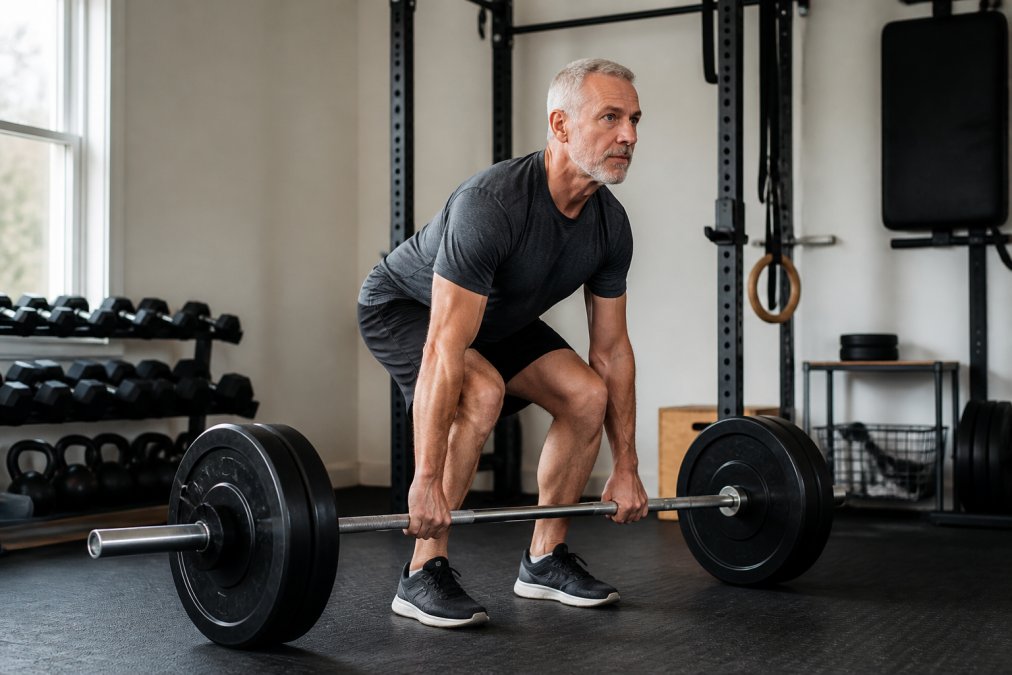
These four movement patterns, squat, deadlift, press, and row, form the backbone of a strength training program for men over 50 and deliver results across all fitness levels.
Joint-Friendly Exercise Modifications
Strength training, when done correctly, improves joint health rather than damaging it. The key is managing intensity, range of motion, and recovery.
Start with a range of motion that feels comfortable. If full squats bother your knees, use box squats or goblet squats. If overhead pressing irritates shoulders, use dumbbells for a more natural path. Trap bar deadlifts reduce lower back stress while building posterior chain strength.
Modify based on your body, not ego. A partial range of motion performed consistently beats a full range that causes pain.
Strength Training Frequency for Older Adults
Most men over 50 respond best to strength training 3-4 days per week, with at least one rest day between sessions targeting the same muscle groups.
Training too hard too often is a common mistake. Recovery capacity decreases with age, so training the same muscle group twice per week works better than three times weekly.
Use either an upper-lower split (upper body one day, lower body the next) or a full-body split (all major patterns in one session, rest a day before the next). Choose based on your schedule and recovery.
Overcoming Psychological Barriers to Starting
The biggest obstacle to strength training after 50 is psychological. Many men carry fears of injury, gym intimidation, or that their body can't handle it. These fears are often overblown and prevent men from starting the program that would improve their health most.
Fear of injury is the primary barrier. Untrained men over 50 are at higher injury risk during everyday activities because they lack strength and stability. A structured strength program reduces injury risk by building muscle and neuromuscular control.
Start conservatively. Perform 2-3 sets of 8-10 reps with a weight you can control completely. After 2-3 weeks, early success builds confidence and counters fear.
Gym intimidation is real. Home training eliminates this problem. A modest setup, dumbbells, a barbell, a bench, removes commuting friction and allows training in privacy. Home training has the highest adherence rate for men over 50.

If you prefer a gym, train during off-peak hours (mid-morning or early afternoon) and use free orientation sessions to reduce anxiety.
Belief that "my body can't handle it" is the third barrier. Adaptation happens quickly. Within 4 weeks, you'll notice improved strength and energy. Within 8 weeks, changes are obvious. This tangible progress builds long-term belief.
Modifying Training for Common Age-Related Conditions
Many men over 50 assume medical conditions disqualify them from strength training. The opposite is true: strength training, when modified appropriately, improves these conditions.
Portable Weight Barbell Set – Home Gym →
Hypertension and cardiovascular concerns: Strength training is safe for men with hypertension. Use moderate weights (6-10 reps) with controlled tempos and 2-3 minute rest periods. Breathe continuously, exhale during the hard part, inhale during the easy part. Consult your physician before starting. Most men find consistent strength training improves blood pressure over 8-12 weeks.
Arthritis and joint pain: Stronger muscles stabilize joints and reduce arthritis pain. Avoid positions that cause pain. Use box squats or goblet squats if full-range squats hurt knees. Use dumbbells for overhead pressing if barbell irritates shoulders. Use trap bar deadlifts if conventional deadlifts stress your lower back. Build strength in a pain-free range of motion, then gradually increase range as pain decreases.
Lower back pain: Strength training, particularly core and posterior chain work, is one of the most effective treatments. Focus on deadlifts, rows, planks, and bird dogs. Start with bodyweight or light loads.
Building Adherence Through Realistic Expectations
The best training frequency is the one you'll actually follow. Consistency over 12 months beats perfection over 12 weeks.
Essential Home Gym Equipment for Strength Training
A modest home setup lets you train consistently without commuting and compounds in value over years.
Recovery Tips for Older Lifters
Recovery is where adaptation happens. You don't get stronger during the workout, you get stronger during rest. But recovery physiology changes significantly after 50, and generic advice misses the specific mechanisms that matter for aging lifters.
How Recovery Changes After 50
Three physiological shifts affect recovery: Sleep architecture becomes fragmented, you may sleep 8 hours but get only 4-5 hours of deep sleep versus 6-7 in your 30s. Testosterone and growth hormone decline, slowing muscle protein synthesis and recovery. Cortisol patterns shift, with baseline cortisol staying elevated longer into afternoon and evening, impairing sleep quality.
Warm-Up and Cool-Down Protocols
Spend 5-10 minutes on general movement (light rowing, jumping jacks, arm circles, leg swings), then perform 1-2 warm-up sets at lighter weight, focusing on movement quality.
Sleep Optimization for Muscle Recovery
Men over 50 should target 7-9 hours nightly, but quality matters as much as quantity. Poor sleep impairs recovery and slows muscle protein synthesis.
Nutrition and Protein Timing for Muscle Synthesis
Aim for 0.7-1 gram of protein per pound of bodyweight daily, spread across 3-4 meals. Distribute protein throughout the day for steady muscle protein synthesis.
Hydration and Electrolyte Balance
Thirst sensation declines after 50. Train with water nearby and drink consistently. Dehydration impairs strength performance and slows recovery.
Building Your First Strength Training Program
A strength training program for men over 50 needs to be consistent, progressive, and sustainable long-term.
Step 1: Start with Progressive Overload
Progressive overload means gradually increasing demands on your muscles through added weight, reps, reduced rest periods, or improved movement quality. Start conservatively and aim to add one rep per session or one set per week.
Step 2: Establish Your Training Split
A full-body split performed 3 days per week works well for most men over 50. Day 1: Squat, bench press, bent-over row. Day 2: Deadlift, overhead press, pull-ups. Day 3: Front squat, incline press, barbell rows. This hits each movement pattern twice per week while allowing adequate recovery.
Step 3: Track Your Workouts and Adjust
Train the same program for 4-6 weeks before changing it. Evaluate: Did strength improve? Did you feel better? If yes, increase weight slightly. If no, adjust exercise selection, volume, or frequency. A program you'll follow beats a perfect program you abandon.
| Program Variable | Recommendation | Frequency |
|---|---|---|
| Training frequency | 3-4 days per week | Ongoing |
| Rest between sessions | At least 1 day | Ongoing |
| Sets per exercise | 3-4 sets | Per session |
| Reps per set | 6-10 reps | Per session |
| Rest intervals | 2-3 minutes | Per exercise |
| Program duration | 4-6 weeks | Before adjusting |
Common Mistakes to Avoid
Avoid ego lifting. A lighter weight performed with control builds more strength and causes less injury than heavy weight performed poorly.
Frequently Asked Questions
How many days a week should a man over 50 do strength training?
Most men over 50 benefit from 3 to 4 days of strength training per week, allowing adequate recovery between sessions. This frequency supports muscle preservation and bone density while reducing injury risk. A common approach is training 3 days weekly with at least one rest day between sessions, or splitting workouts into upper-lower body days across 4 sessions. Rest days are crucial because recovery capacity decreases with age, and muscle protein synthesis requires proper time between strength training bouts.
What are the best strength exercises for men over 50?
Compound movements that engage multiple muscle groups are most effective: squats, deadlifts, bench presses, rows, and overhead presses. These exercises build functional strength and bone density while improving metabolic rate. Modify ranges of motion to protect joints, and start with lighter loads to master form. Kettlebell exercises like swings and goblet squats offer joint-friendly alternatives. Avoid ballistic movements or heavy singles early; instead use moderate weight with higher repetitions (8-12 reps) to build hypertrophy and neuromuscular control safely.
Can men over 50 build muscle without joint pain?
Yes, with proper technique and smart programming. Warm-up thoroughly for 5-10 minutes before lifting to prepare joints and connective tissue. Use full range of motion without forcing end ranges that cause discomfort. Progressive overload gradually, increasing weight by small increments rather than jumping up dramatically. Incorporate mobility work and flexibility training on non-training days. Quality equipment like adjustable dumbbells and benches supports consistent, pain-free training. Recovery strategies including adequate protein intake, sleep, and rest days are essential for injury prevention and muscle preservation.
What should men over 50 eat to support strength training?
Protein intake is critical for muscle synthesis: aim for 0.7-1 gram per pound of body weight daily, spread across meals. Include complete proteins from meat, fish, eggs, and dairy. Carbohydrates fuel workouts and support recovery; whole grains and vegetables provide sustained energy. Healthy fats support hormone production and joint health. Stay hydrated consistently throughout the day. Consider supplementation if whole foods fall short, but prioritize real food first. Timing protein around workouts supports hypertrophy, though total daily intake matters most for men over 50.