

Table of Contents
- Assess Your Current Fitness Level and Set Realistic Goals
- Home Workout Plan for Beginners: Building Your Foundation
- How Long Should a Home Workout Be for Maximum Results
- Best Home Workout Equipment for Strength Training
- Structure Your Home Workout Routine with Progressive Overload
- Recovery Optimization and Consistency in Home Training
- Frequently Asked Questions
Last Updated: September 3, 2026
Assess Your Current Fitness Level and Set Realistic Goals
Before starting any home workout routine, establish an honest baseline. Understanding where you're starting from determines which exercises you can safely perform, how much volume your body can handle, and what progression looks like over the next 90 days.
Assess three things: cardiovascular endurance, muscular strength, and mobility. For endurance, walk or jog for 10 minutes and note how you feel. For strength, do as many push-ups as you can with good form. For mobility, try touching your toes, doing a deep bodyweight squat, and rotating your spine gently. Write these down to reference in 4-6 weeks.
Set goals that align with your actual life, not social media standards. A realistic goal for someone working 50 hours a week differs from someone with flexible hours. Effective goals are specific, measurable, and tied to a timeline. Instead of "get stronger," try "add 10 pounds to my dumbbell press in 12 weeks." Instead of "lose weight," try "reduce body fat by 5% in 16 weeks while maintaining strength."
Home Workout Plan for Beginners: Building Your Foundation
A beginner home workout plan should focus on movement quality and consistency, not intensity. This foundation prevents injury and builds the habit that makes everything else possible.
A typical beginner plan includes three sessions per week, spaced at least one day apart, lasting 30-40 minutes each including warm-up and cool-down (acsm.org). Each session should include:
- 5-10 minute warm-up (light cardio + dynamic stretching)
- 3-4 compound movements (exercises that work multiple muscle groups)
- 2-3 isolation exercises (single-muscle focus)
- 5-10 minute cool-down (static stretching + breathing)
Compound movements are your foundation: push-ups, bodyweight squats, lunges, rows, and planks. They build strength efficiently because they work multiple joints and muscle groups simultaneously. Start with 3 sets of 8-12 repetitions per exercise, resting 60-90 seconds between sets.
For your first month, prioritize proper form over adding weight or volume. A push-up done well builds strength, stability, and confidence. Film yourself or use a mirror to verify your form: shoulders stable, core tight, full range of motion.
Bodyweight exercises alone are enough to build a solid foundation. Optional equipment expands your options: the Sports Products Fitness Equipment Indoor Pull-Up Bar ($54.99) enables pulling movements, while the Adjustable Magnetic Barbell Dumbbell ($252.99) allows progressive resistance without requiring a full rack.

How Long Should a Home Workout Be for Maximum Results
Most people see results from 30-45 minute sessions, three to four times per week. Session length matters less than consistency and intensity. A 30-minute focused workout beats a 90-minute scattered one every time.
For strength training, 30-45 minutes is ideal. This allows time for a proper warm-up (5-10 minutes), 3-5 compound exercises with adequate sets and rest (20-30 minutes), and a cool-down (5-10 minutes). Anything shorter cuts into recovery time; anything longer adds volume that doesn't proportionally increase results.
For cardiovascular training, 20-30 minutes of moderate intensity or 10-15 minutes of vigorous activity works well. This can be a separate session or combined with strength training as a warm-up or finisher.
Higher intensity (heavier weights, shorter rest periods) requires shorter sessions because your central nervous system fatigues faster. Most people training at home benefit from moderate intensity and moderate duration.
Start with 35-40 minutes per session and track how you feel and perform. If you're recovering well and progressing, keep it. If constantly sore or progress stalls, reduce to 30 minutes and focus on intensity. If you feel like you're leaving gains on the table, add 5-10 minutes.
Best Home Workout Equipment for Strength Training
The best home workout equipment depends on your space, budget, and goals. Certain pieces deliver the most return on investment for most people.
Adjustable dumbbells are the foundation. The Adjustable Magnetic Barbell Dumbbell ($252.99) uses a magnetic quick-change system so you can swap weight in seconds, keeping rest periods consistent and your workout flowing.
A weight bench expands your options significantly. The New Upgraded Multi-function Weightlifting Bench ($821.99) adjusts to multiple angles, flat, incline, decline, letting you target different muscle groups and movement patterns.

A pull-up bar is essential for upper body pulling movements. The Sports Products Fitness Equipment Indoor Pull-Up Bar ($54.99) mounts in any doorway and supports serious training. If you can't do pull-ups yet, use resistance bands to reduce the load.
Resistance bands are underrated. They're portable, affordable, and provide variable resistance useful for warm-ups, assistance, and isolation work.
For those with more space and budget, the Portable Weight Barbell Set ($1,011.99) lets you perform compound movements like squats and deadlifts in a compact footprint.

The progression: start with bodyweight and a pull-up bar. Add adjustable dumbbells when ready to scale resistance. Add a bench for more pressing options. Add a barbell and rack if committed to long-term strength training.
Structure Your Home Workout Routine with Progressive Overload
Progressive overload is the principle that makes workouts actually work. Without it, your body adapts and progress stops. With it, you keep improving month after month.
Progressive overload means gradually increasing the demands on your muscles through more weight, more reps, more sets, shorter rest periods, or better form. Something changes each week or every other week so your body never fully adapts.
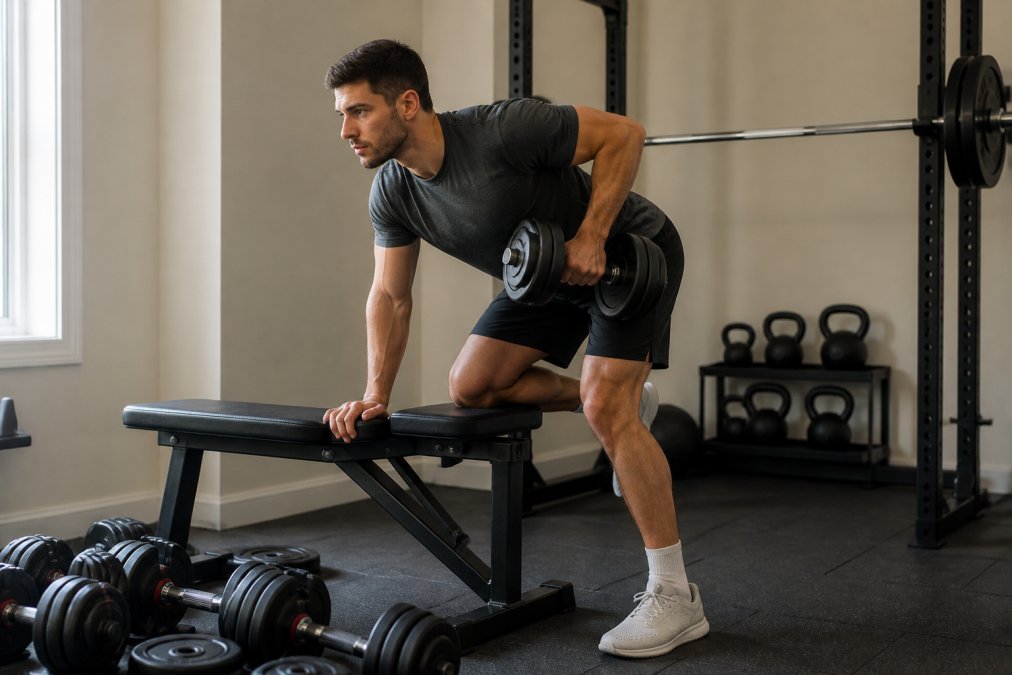
A practical example: Week 1, do 3 sets of 10 dumbbell presses at 25 pounds. Week 2, do 3 sets of 11 reps at 25 pounds. Week 3, do 3 sets of 12 reps at 25 pounds. Week 4, increase to 30 pounds and drop back to 10 reps, starting the cycle again.
Track your workouts. Write down the exercise, weight, reps, and sets for each session. Without tracking, you'll repeat the same workout indefinitely and wonder why you're not progressing. Use a simple notebook or phone app to log each session.
Progressive overload also applies to bodyweight exercises. Progress from knee push-ups to full push-ups to decline push-ups to one-armed variations. Progress from bodyweight squats to goblet squats to pistol squats.
Rest intervals matter for progressive overload. Shorter rest periods (30-45 seconds) increase metabolic stress and muscular endurance. Longer rest periods (2-3 minutes) let you recover more fully and lift heavier weight. Most people training at home benefit from 60-90 second rest periods.
Aerobic vs. Anaerobic Training in Your Home Routine
Aerobic activity uses oxygen to produce energy and includes steady-paced running, cycling, walking, or swimming. It builds cardiovascular health, improves endurance, and supports recovery at lower intensity without interfering with strength training recovery.
Anaerobic training happens without oxygen: sprinting, heavy lifting, or high-intensity intervals. It builds power, strength, and muscular endurance but is more taxing on your nervous system and requires more recovery.
Most home routines should include both. A typical week might include three strength training sessions (anaerobic) and two moderate-intensity aerobic sessions (walking, light jogging, or cycling). This builds strength while maintaining cardiovascular health.
For limited time, high-intensity interval training (HIIT) combines both. Alternating 20-30 seconds of vigorous activity with 30-40 seconds of recovery for 10-15 minutes provides both anaerobic stimulus and cardiovascular benefit. But HIIT is taxing and shouldn't replace all steady-state aerobic work.
Warm-Up and Cool-Down Protocols
A proper warm-up takes 5-10 minutes and serves two purposes: raising core temperature and preparing your nervous system. Start with 2-3 minutes of light cardio, then do 5-8 minutes of dynamic stretching and movement preparation. Dynamic stretching means moving through a range of motion: arm circles, leg swings, bodyweight squats, lunges.
The warm-up should be specific to your workout. If doing upper body pressing, include arm circles, band pull-aparts, and light pressing movements. If doing lower body work, include leg swings, bodyweight squats, and glute activation.
Cool-downs bring your heart rate down gradually, start the recovery process, and improve flexibility. A 5-10 minute cool-down includes 2-3 minutes of easy movement followed by 5-7 minutes of static stretching. Hold stretches for major muscle groups, hamstrings, quads, chest, shoulders, and hip flexors, for 20-30 seconds each.
Recovery Optimization and Consistency in Home Training
Recovery is where adaptation happens. You don't build muscle or strength during the workout; you build it during recovery. Without adequate recovery, you'll plateau or regress.
Recovery includes sleep, nutrition, and active recovery. Sleep is non-negotiable. Most people need 7-9 hours for adequate muscle recovery and hormonal balance (the CDC). Prioritize sleep before adding more training volume.
Nutrition supports recovery through protein and calories. Your muscles need protein to rebuild stronger. A common guideline is 0.7-1 gram of protein per pound of body weight daily (peer-reviewed research). Calories matter too; if you're in a large calorie deficit, your body prioritizes survival over muscle building.
Active recovery on rest days improves blood flow without adding training stress. This includes light walking, easy cycling, yoga, or foam rolling. Many people find that 20-30 minutes of easy movement on rest days improves how they feel and perform.
Consistency trumps intensity. A moderate workout done every week for a year beats an intense workout done sporadically. Your body adapts to consistent stimulus, not occasional heroic efforts. Track consistency by recording workouts. After 4-6 weeks, you'll see patterns that let you plan around obstacles.
The reality of home training is that life happens. Missed sessions, disrupted schedules, travel are normal. The goal isn't perfection but getting back on track quickly. The people who progress are the ones who stay consistent over months and years.
Structuring an effective home workout routine comes down to honest assessment, realistic goals, and consistent execution. You've now seen how to assess your fitness level, design a beginner-friendly plan, determine optimal session length, select equipment that delivers results, apply progressive overload, and prioritize recovery.
The missing piece for most people isn't knowledge but having the right tools and support to actually execute. PureFitnessWarehouse.com provides both. From adjustable dumbbells and multi-function benches to pull-up bars and suspension training equipment, we've curated a selection specifically designed for home-based training. Our data-driven approach means every product in our catalog has been selected to support your progression toward measurable results. Whether you're tracking strength gains with progressive overload or optimizing recovery for consistency, we provide the equipment and expertise to help you reach your personal best.
Frequently Asked Questions
What is the best way to structure a home workout routine for beginners?
Start with 3 days per week, alternating between upper body and lower body sessions. Each session should last 30-45 minutes. Focus on compound movements like squats, push-ups, and rows using bodyweight or adjustable dumbbells. Include 5-10 minutes of warm-up and cool-down. Beginners should prioritize consistency and proper form over heavy weight. Gradually increase intensity every 2-3 weeks as your strength improves.
How long should a home workout be to see results?
Most effective home workouts last 30-60 minutes, including warm-up and cool-down. For beginners, 30-45 minutes is ideal. For intermediate to advanced trainees, 45-60 minutes allows adequate training volume. Shorter micro-workouts of 15-20 minutes can work if you're consistent and maintain intensity. The key is frequency and consistency, three 40-minute sessions per week beats one 90-minute session.
What equipment do I need to start strength training at home?
You can start with just bodyweight exercises, but adjustable dumbbells and a pull-up bar dramatically expand your options. An adjustable magnetic barbell dumbbell set ($252.99) lets you change weight between sets instantly. A multi-function weightlifting bench ($821.99) enables pressing movements and core work. A pull-up bar ($54.99) adds upper body pulling strength. For a complete setup, consider a portable barbell set ($1,011.99) for compound lifts.
How do I know if I'm making progress in my home workout routine?
Track metrics like reps completed, weight lifted, and rest intervals between sets. Record workouts in a notebook or app to monitor progressive overload. Measure body composition changes monthly. Notice improvements in functional movement, easier push-ups, more pull-ups, better form. Wearable trackers help monitor recovery metrics like sleep and heart rate variability. Progressive overload means increasing sets, reps, weight, or decreasing rest time each week.
Can I build muscle with a home workout routine?
Yes. Muscle hypertrophy requires resistance training with progressive overload, adequate protein intake, and recovery. Home workouts using dumbbells, barbells, and bodyweight exercises trigger muscle growth effectively. Perform 8-12 reps per set with moderate to vigorous intensity. Include compound movements that work multiple muscle groups. Rest 48 hours between training the same muscle groups. Consistency over 8-12 weeks shows visible muscle development.
How do I prevent soreness and recover between home workouts?
Soreness (DOMS) decreases with consistent training. Proper warm-up and cool-down reduce recovery time. Active recovery on rest days, light walking, yoga, or stretching, improves mobility and flexibility. Sleep 7-9 hours nightly for muscle repair. Nutrition matters: adequate protein supports recovery. Foam rolling and stretching address muscle tightness. Spacing workouts 48 hours apart for the same muscle groups allows sufficient recovery time before the next training session.
This article was written using GrandRanker